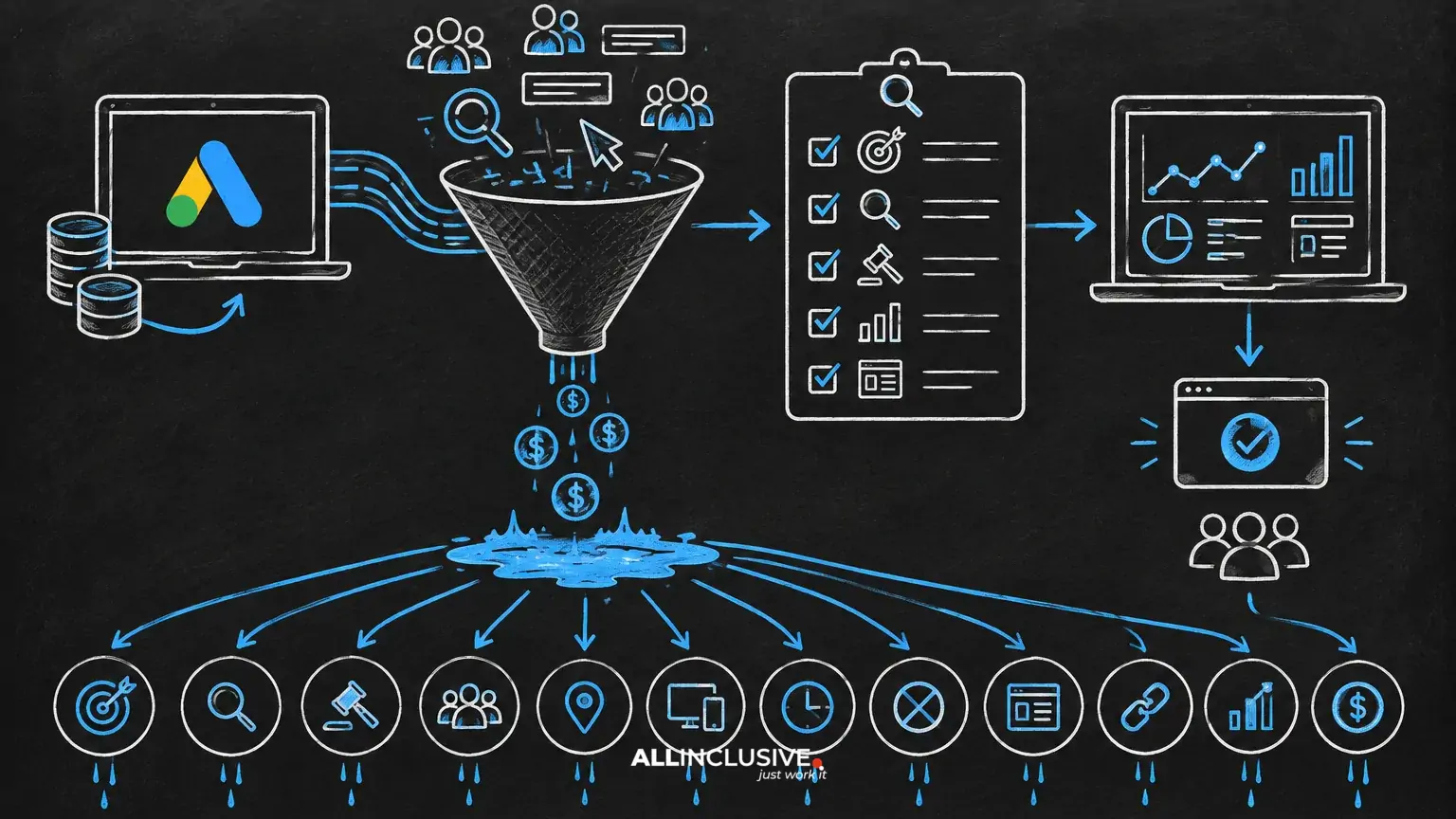
Google Ads waste is the portion of paid-search spend that does not create a meaningful business outcome. It can come from irrelevant searches, weak qualification, poor measurement, duplicated coverage or a landing-page experience that prevents viable prospects from converting.
The fastest way to reduce waste is not to pause everything that looks expensive. It is to trace spend from impression to qualified conversion, separate unavoidable testing costs from preventable leakage, and fix the highest-value failure points first.
This guide covers 12 places budget commonly leaks and a practical sequence for auditing them.
1. Irrelevant search queries
Keyword targeting is only an input. The actual query determines whether an impression had a realistic chance of producing value. Broad or ambiguous terms can attract searches from students, job seekers, do-it-yourself users, competitors, unrelated industries or people looking for a different product category.
Review search-term data by campaign, ad group, match type and conversion status. Look for recurring themes rather than reacting to isolated low-volume queries. Add exclusions where the intent is consistently outside your offer, and consider whether the underlying keyword should be narrowed or moved to a controlled test.
2. Poorly managed negative keywords
Negative keywords are not a one-time setup task. New language, seasonal demand and campaign expansion create new ways for ads to appear against weak intent.
Build a shared exclusion framework for obvious non-commercial or irrelevant themes, then add campaign-specific negatives where products, services or audiences differ. Be cautious with broad exclusions: an overly aggressive list can remove valuable variations. Every exclusion should be evaluated against the question, “What legitimate query might this also block?”
3. Brand and non-brand intent mixed together
Brand searches and non-brand searches usually have different economics, intent and competitive conditions. Combining them can make performance look healthier than prospecting really is, because brand demand often converts more efficiently.
Separate reporting and, where appropriate, campaign structures for brand, non-brand, competitor and product-specific intent. This does not mean brand traffic is unimportant. It means you should know which demand you are harvesting and which demand you are creating or intercepting.
4. Geographic leakage
Location settings, service areas and operational coverage need to align. A company serving selected regions can waste budget on users outside those areas, while a local provider may pay for searches from people who cannot reasonably become customers.
Audit location performance at a level that is useful for your sales process. Compare spend and qualified outcomes by region, not just clicks or leads. For location-sensitive businesses, confirm that targeting reflects where users are located or where they are showing interest, according to the campaign’s intended strategy and available platform controls.
5. Time-of-day and day-of-week inefficiency
Some accounts spend heavily when response capacity is low, sales teams are unavailable or conversion quality drops. Others overcorrect by excluding evenings, weekends or early hours without enough evidence.
Compare conversion quality and downstream outcomes by hour and day. A lead generated outside business hours is not automatically waste if follow-up is reliable. Conversely, a low-cost lead may be expensive in practice if it is rarely contacted or qualified. Use operating capacity and business value alongside platform conversion data.
6. Weak audience and query qualification
Traffic can be technically relevant but commercially weak. For example, a searcher may understand the topic yet lack the budget, authority, urgency or geographic fit required to become a customer.
Improve qualification through the offer, ad copy and landing page. State the audience served, use case, service area, minimum engagement context or product category when that information helps filter demand. Better qualification may reduce raw conversion volume while improving the value of the conversion pool.
7. Conversion tracking that counts the wrong thing
Optimization cannot outperform the signal it receives. Counting page views, duplicate form submissions, low-intent downloads or accidental calls as primary conversions can direct spend toward actions that do not represent business progress.
Map the funnel before changing bids. Identify the actions that indicate genuine intent, define which should be primary for optimization, and separate micro-conversions from qualified outcomes in reporting. If sales quality is available, use it to evaluate whether the account’s conversion signals reflect reality.
Tracking problems are often mistaken for bidding problems. Validate tags, event conditions, attribution settings and lead deduplication before concluding that a campaign is inefficient.
8. Delayed or missing feedback from sales
Lead-generation campaigns can continue to favor volume when the advertising platform cannot distinguish a qualified opportunity from an unworkable inquiry. This is especially costly in B2B programs with long sales cycles.
Define the stages that matter: qualified lead, accepted opportunity, booked meeting, pipeline or another defensible business milestone. Then establish a process for returning reliable outcome data to marketing and media decisions. The mechanics vary by stack, but the strategic principle is consistent: optimize toward evidence of value, not merely the first form completion.
9. Bidding against a weak objective
Automated bidding can be useful, but it does not decide what your business should value. If the objective is incomplete, unstable or dominated by low-quality conversions, the system may pursue the wrong outcome efficiently.
Before changing bid settings, inspect conversion volume, signal consistency, budget limits and the business objective. Ask whether the campaign is meant to maximize qualified demand, revenue, efficiency, reach or learning. Avoid judging a bidding approach from a short, noisy period or changing several major variables at once.
10. Ad-to-landing-page mismatch
A relevant click can still become wasted spend when the destination page changes the promise, hides key information or makes the next step difficult. Message mismatch is particularly common when one landing page serves many keywords or audiences.
Check whether the page confirms the user’s problem, offer, audience and next action quickly. Review mobile usability, load experience, form friction, trust evidence and qualification requirements. A useful landing-page audit should connect search intent to page content rather than focus only on visual design.
For a deeper framework, see Google Ads Landing Pages: Message Match, Speed and Conversion.
11. Ads and assets that fail to qualify or persuade
Ad copy can attract the wrong clicks when it is vague, overbroad or disconnected from the offer. It can also waste available demand when it does not explain the differentiator or set an accurate expectation for the destination.
Review assets as a system: headlines, descriptions, sitelinks, callouts and structured information should support distinct intent paths rather than repeat the same claim. Test meaningful differences in audience, problem, proof and action. Do not treat every variation as a winner based solely on click-through rate; assess qualified outcomes and the role of the ad in the journey.
For an asset-specific reference, read Google Ads Assets: Sitelinks, Callouts, Snippets and More.
12. Budget allocation that ignores marginal value
Budget waste can occur even when individual campaigns appear healthy. A campaign may receive too much budget after reaching its strongest demand, while another campaign with better incremental potential remains constrained.
Review allocation by intent, marginal performance, business priority and demand availability. Do not shift budget solely toward the lowest cost per lead. Compare qualified outcomes, conversion lag, sales capacity and the role each campaign plays. Budget constraints and impression-share metrics can help explain missed demand, but they do not by themselves prove that more spend will be profitable.
See Search Lost IS (Budget): How to Diagnose Budget Constraints for a focused diagnostic approach.
How to audit Google Ads waste in the right order
- Validate measurement. Confirm that the conversions used for reporting and optimization represent real actions and are not duplicated.
- Inspect query quality. Identify irrelevant themes, low-intent modifiers and unexpected demand before making broad structural changes.
- Segment performance. Break results down by campaign, intent, geography, device, time and audience where the data supports a useful decision.
- Check commercial quality. Compare leads or conversions with qualification, revenue, pipeline or another downstream indicator.
- Review the path after the click. Test message match, usability, trust and friction on the most expensive or highest-volume destinations.
- Reallocate deliberately. Move budget only after distinguishing tracking issues, demand limitations and true efficiency differences.
What not to do when reducing waste
Do not equate low cost with efficiency, high click-through rate with intent or low conversion volume with failure. Do not pause every keyword that has not converted without considering volume, lag and strategic coverage. Do not apply a large negative-keyword list without checking for blocked demand. And do not change targeting, creative, landing pages and bidding simultaneously if you need to learn which intervention created the result.
A controlled audit is more valuable than a dramatic cleanup. Keep a change log, define the decision each change is intended to address, and allow enough time or volume to evaluate the relevant outcome.
A practical definition of paid-search efficiency
Efficient Google Ads is not necessarily the account with the cheapest click or the fewest impressions. It is the account that converts an appropriate share of available demand into outcomes the business values, while making uncertainty visible.
That requires three connected disciplines: demand control through targeting and exclusions, signal quality through measurement and feedback, and conversion quality through ads, landing pages and follow-up. If any one of these is weak, budget can leak even when the dashboard looks active.
Use this article as an audit checklist, then prioritize the leaks by expected business impact and confidence in the diagnosis. For broader guidance on planning and managing paid acquisition, visit paid search and explore the wider paid media resource.