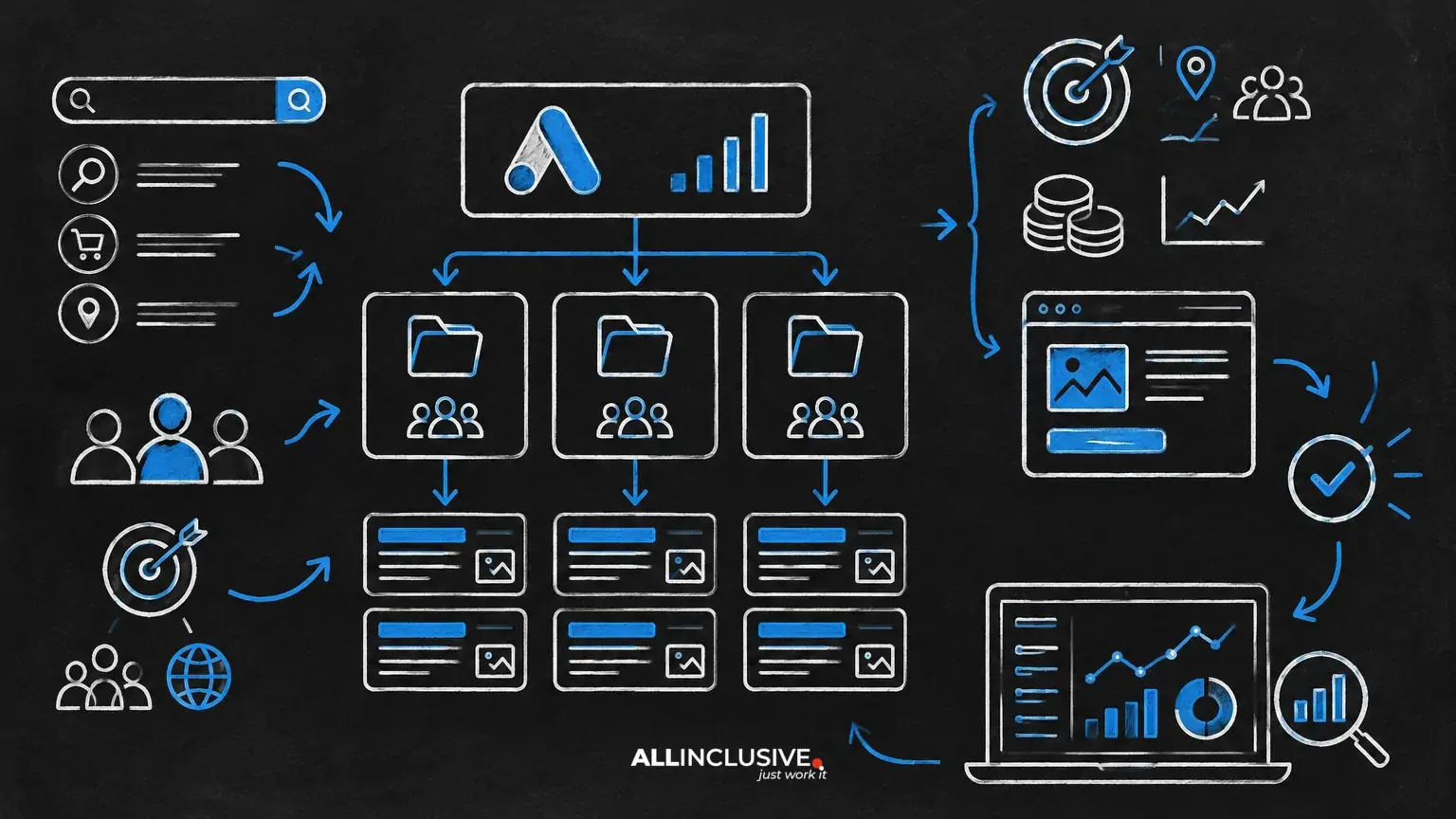
A strong Google Ads account structure makes it easier to control budgets, match ads to search intent, evaluate performance and scale what works. A weak structure creates blurred reporting, mixed audiences and difficult optimization—even when the ads themselves are well written.
The right structure is not the one with the most campaigns or the most granular ad groups. It is the simplest setup that gives each materially different business objective, audience, budget constraint or message enough control to perform and be measured properly.
The basic hierarchy of a Google Ads account
Search accounts are typically organized in layers:
- Account: the overall advertising environment, including billing, access, conversion settings and shared governance.
- Campaigns: the primary level for budget allocation, broad targeting choices, bidding direction and reporting.
- Ad groups: groups of closely related keywords, ads and search intent within a campaign.
- Keywords and search terms: the targeting inputs and the actual queries that trigger ads, where applicable.
- Ads and assets: the messages and supporting information shown to potential customers.
- Landing pages: the destination experience that completes the journey and supports conversion.
These layers should reflect meaningful differences in strategy. They should not simply mirror every page on a website or every variation of a keyword.
Start with business objectives and intent
Before naming campaigns, map the demand you want to capture. A useful planning model considers four questions:
- What action is valuable: a purchase, qualified lead, donation, application, call or another outcome?
- What level of intent does the search express?
- Which offer, message and landing page best answer that intent?
- What budget, bidding approach or reporting view must be controlled separately?
For example, a nonprofit may need to distinguish searches for its organization, searches for a specific program and broader searches related to a social issue. A business-to-business company might separate brand, high-intent service terms, category research and competitor-related demand. The correct divisions come from differences in business value and user intent, not from arbitrary keyword volume.
When to create separate campaigns
Create separate campaigns when you need meaningful control at the campaign level. Common reasons include:
- Different budgets: Brand protection and non-brand acquisition often deserve distinct budget decisions.
- Different geographic priorities: Regions with different markets, languages, regulations or sales coverage may require separate management.
- Different business goals: Lead generation, ecommerce revenue, donations and awareness should not automatically share the same optimization logic.
- Different audiences or intent: Existing-brand searches and problem-aware searches often require different messages and landing pages.
- Different operational ownership: Separate teams, approval processes or reporting requirements may justify a division.
- Different bidding or scheduling needs: If groups require materially different controls, campaign separation may be useful.
Do not split campaigns merely because two keywords use different word order or because a product has many minor variations. Excessive fragmentation can reduce usable data, complicate maintenance and make budget allocation less flexible.
Brand and non-brand campaigns
A brand campaign usually captures people already searching for the organization, company or product name. Non-brand campaigns target category, problem or solution demand. Keeping them separate can clarify incremental acquisition, protect the brand budget and make reporting easier.
Brand terms may have different conversion rates and economics from non-brand terms. Combining them can make a blended cost-per-lead or return figure look stronger without showing how much demand came from people who already knew the brand.
Geographic campaigns
Separate geographic campaigns are most useful when locations differ in budget, offer, language, legal requirements, sales coverage or performance expectations. If every location uses the same strategy and needs no independent budget control, one campaign with appropriate location targeting may be more efficient.
Use geographic segmentation to solve a management problem—not to create a map of every service area.
How to organize ad groups around intent
Ad groups should contain closely related searches that can share a compelling ad message and a relevant landing page. A practical test is:
Could one ad and one landing page answer the dominant intent of every keyword in this ad group without sounding generic?
If the answer is no, separate the themes. If the answer is yes, further splitting may add complexity without improving relevance.
Use intent themes, not single-keyword silos
Consider a company offering payroll software. Potential ad-group themes might include:
- Payroll software for small businesses
- Payroll tax filing software
- Employee payroll automation
- Payroll software pricing
Each theme suggests a distinct concern or evaluation stage. A single ad group containing every payroll-related keyword would make it difficult to write specific ads and direct users to the best page. Conversely, creating one ad group for every close keyword variant may be unnecessary if the same message and page apply.
Separate by landing-page promise
Landing-page alignment is often the clearest structural signal. If one set of searches should reach a pricing page and another should reach a nonprofit program page, they should generally not share the same ad group. Separate structure allows the ad, keyword theme and destination to make the same promise.
Build a naming convention that supports management
A naming convention should make the account understandable without opening every setting. Include only information that helps teams filter, report or make decisions. A campaign name might include:
- Network or campaign type
- Brand or non-brand status
- Market or region
- Business line or offer
- Language, where relevant
For example: Search | Nonbrand | US | Payroll Software. Ad-group names can describe the intent theme, such as Tax Filing or Small Business.
Avoid names that encode temporary details, such as a short-term bid setting, unless the naming system is maintained when strategy changes. Document abbreviations and apply the convention consistently across campaigns, ad groups, ads and reporting.
Account structure and keyword strategy
Structure and keyword targeting should be planned together. Keyword research identifies demand themes; account structure determines where those themes receive budgets, messages and landing pages. For a deeper treatment of query categorization and targeting choices, see Google Ads keyword strategy.
Do not assume every keyword needs its own ad group. Group terms when they share:
- Search intent
- Value proposition
- Ad copy
- Landing page
- Conversion objective
Separate terms when a difference would change the ad promise, destination, audience qualification or business value.
Use negative keywords to protect campaign boundaries
Negative keywords help prevent irrelevant queries and reduce overlap between themes. They are especially important when multiple campaigns cover related subjects, such as brand and non-brand demand or free and paid offers.
Build negatives from known exclusions and actual search-term data. Review them carefully: an overly broad exclusion can block valuable demand, while a missing exclusion can make reporting and budget control less reliable. The related guide to Google Ads negative keywords covers the working process in more detail.
Match structure to measurement
A campaign structure cannot compensate for unclear conversion definitions. Before launch, identify the actions that matter and decide which should guide optimization versus reporting only.
For lead generation, a submitted form may be an initial conversion, while a qualified opportunity or closed deal is the commercial outcome. For nonprofits, a donation, volunteer registration or program application may each have different value. If all actions are blended without qualification, the account may optimize toward the easiest action rather than the most valuable one.
Use consistent tracking conventions for campaigns, ads and landing pages. Check that conversion actions fire once, calls or offline outcomes are handled appropriately for the business model, and reporting distinguishes primary outcomes from supporting interactions.
Common Google Ads structure mistakes
One campaign for everything
This approach is easy to launch but often hides important differences in intent, economics and budget priority. It can work for a small, focused offering, but it should be a deliberate choice rather than a default.
One campaign per keyword
Extreme granularity creates administrative overhead and can divide activity into small pockets. Use it only when the control or reporting benefit clearly justifies the added complexity.
Mixing incompatible intent
Informational, comparison and high-intent searches may require different messages and destinations. Combining them can produce vague ads and misleading performance averages.
Duplicating the same keyword theme everywhere
Unnecessary duplication can create internal competition, unclear ownership and difficult diagnosis. Establish campaign boundaries and use negatives or tighter thematic organization where appropriate.
Structuring around website navigation alone
Website menus are designed for browsing, not necessarily for paid-search control. A single page may serve several intents, while one user need may be addressed across multiple pages. Let search behavior and business decisions shape the account.
A practical implementation process
- List objectives and conversion actions. Separate acquisition, retention, donations, sales and other goals where their economics differ.
- Map search themes. Group queries by intent, audience, offer and level of qualification.
- Identify campaign-level controls. Note where budgets, regions, languages, schedules, bidding approaches or reporting must differ.
- Assign ad groups. Put closely related keywords together only when they can share an ad message and landing page.
- Define exclusions. Add known irrelevant themes and boundaries between campaigns, then plan regular search-term reviews.
- Write the naming and tracking rules. Make the structure legible to anyone responsible for optimization or reporting.
- Validate the journey. Check keyword-to-ad relevance, ad-to-page continuity, form behavior, calls and conversion measurement before launch.
- Review after real queries arrive. Adjust based on search terms, conversion quality, budget constraints and emerging intent—not on structure preference alone.
How to know whether the structure is working
Evaluate structure by management outcomes. You should be able to answer questions such as:
- Which intent themes receive budget?
- Can high-value demand be separated from low-value or exploratory demand?
- Do ads accurately reflect the searches they serve?
- Can each important campaign reach the most relevant landing page?
- Are conversion results interpretable by business objective?
- Can a team member find and change the right setting without guesswork?
Performance metrics still matter, but structure should not be judged by a single blended metric. Review spend distribution, search-term relevance, conversion quality, impression coverage where meaningful, landing-page alignment and the time required to manage the account.
Account structure is one part of a broader paid media operating system. It works best when campaign design, creative, landing pages, measurement and optimization reinforce one another. Keep the structure as simple as possible, but give every important difference in intent, value or control a clear home.
For broader strategic context, see our paid search resource.