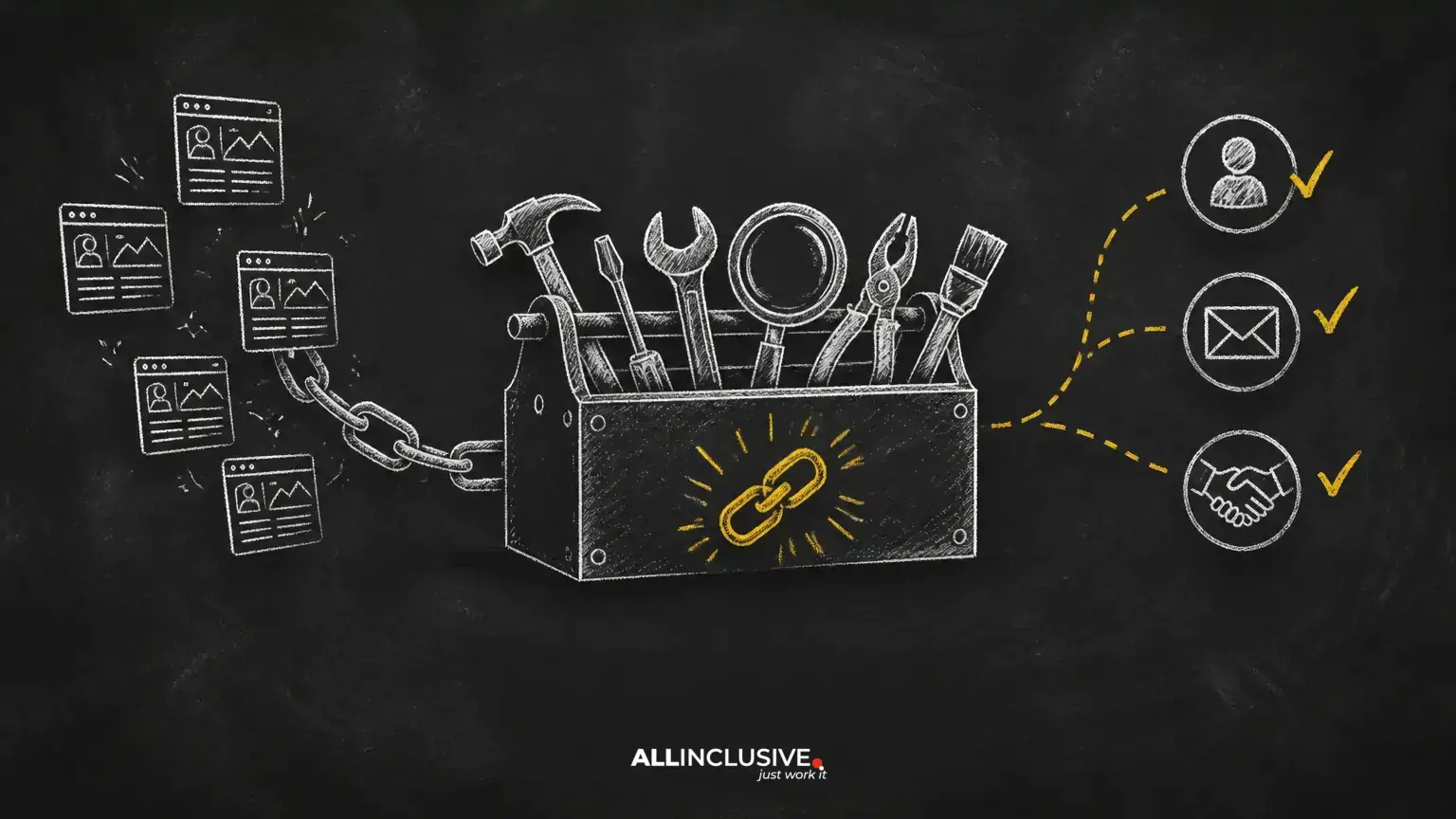
Link-building tools can make research and outreach more organized, but software cannot turn an irrelevant pitch into a worthwhile editorial mention. The right platform should help you identify credible opportunities, understand why a link may be useful, manage personalized outreach, and review what happened after publication.
This guide explains how to evaluate link-building tools without relying on inflated authority scores or promises of automatic rankings. For a broader view of strategy, see the Allinclusive link-building guide.
What a link-building tool should help you do
A useful tool supports a repeatable process rather than replacing judgment. Most platforms focus on one or more of these jobs:
- Discover opportunities: Find sites, pages, publications, organizations, or unlinked brand mentions that may be relevant.
- Research link profiles: Examine referring domains, linked pages, anchor text, and competitor patterns.
- Qualify prospects: Filter out irrelevant, low-quality, inaccessible, or commercially unsuitable targets.
- Manage outreach: Organize contacts, pitches, follow-ups, responses, and campaign status.
- Monitor outcomes: Check whether an earned link is live, relevant, technically accessible, and still present.
- Report work: Connect outreach activity with pages, relationships, and meaningful business or visibility goals.
These functions are related but not identical. A backlink database may be excellent for competitive research while offering little help with contact discovery or relationship management. An outreach platform may handle workflow well but depend on a separate data source for prospecting.
Core categories of link-building tools
Backlink research platforms
Backlink research tools provide a view of links pointing to a domain or page. They can help you identify sites that reference competitors, discover content attracting citations, and investigate changes in a link profile.
Use this category for questions such as:
- Which relevant publications link to several competitors?
- What kinds of pages attract links in this market?
- Which pages on our site receive links, and which important pages receive little attention?
- Are there obvious broken or outdated references that could support a useful replacement?
Do not treat a database as a complete record of the web. Coverage varies, links can disappear, and metrics are estimates. Review the actual page before adding a domain to an outreach list.
Prospecting and link-opportunity tools
Prospecting tools combine keyword, competitor, content, and sometimes brand-mention research to produce possible targets. They are valuable when a team needs to move from a broad market question to a manageable list of prospects.
The best output is not the longest list. It is a prioritized list with a clear reason for contact, such as an article that references an outdated resource, a relevant editorial roundup, a missing local resource, or a journalist who regularly covers the subject.
Outreach and relationship-management tools
Outreach software helps teams keep communication organized. Useful capabilities may include contact records, campaign stages, reminders, templates, personalization fields, reply tracking, and link-status monitoring.
Automation should reduce administration, not produce identical messages at scale. A system that makes it easy to send irrelevant bulk email can damage deliverability and relationships faster than it creates opportunities. Look for controls that support review, segmentation, suppression, and clear ownership.
Digital PR and media-research tools
For organizations with genuinely newsworthy expertise, digital PR tools can support journalist research, story development, media monitoring, and coverage tracking. They are most useful when the team can provide original insight, timely commentary, data it has permission to share, or a strong subject-matter source.
These tools should be evaluated as PR workflow systems, not as guaranteed backlink generators. Coverage may produce a mention without a link, and a link may not be the primary value of a successful media relationship.
How to compare link-building tools
1. Start with the job to be done
Write down the bottleneck before comparing features. A small team may need a simple prospect spreadsheet and a reliable research subscription. A larger team may need permissions, shared pipelines, contact history, and reporting. An agency may prioritize multiple projects, exports, and client-ready documentation.
Common starting points include:
- Finding relevant sites that cite competing resources
- Identifying unlinked mentions of a brand or original research
- Managing personalized outreach across several contributors
- Recovering broken or lost links
- Tracking digital PR coverage and relationships
2. Evaluate data quality, not just database size
A large index can still create poor results if it contains stale, duplicated, irrelevant, or inaccessible prospects. Test a tool with a sample of known websites and inspect whether it identifies important links accurately enough for your process.
Ask whether the platform lets you see the source page, destination URL, link context, and date or status information. A domain-level score is not a substitute for reading the page where a link appears.
3. Check relevance and qualification controls
Useful filters may include topic, location, language, page type, estimated traffic, link status, publication type, and competitor overlap. More filters are not automatically better; they should help a reviewer explain why a prospect belongs on the list.
Build a qualification rubric before outreach. For example, score each prospect on topical fit, audience value, editorial credibility, likelihood of a useful collaboration, and the strength of the proposed resource. Keep the rubric simple enough that different team members apply it consistently.
4. Inspect outreach safeguards
If outreach is part of the platform, review how it handles personalization, approval steps, follow-up limits, unsubscribes, bounced addresses, duplicate contacts, and campaign pausing. These details matter more than a collection of decorative dashboards.
Templates should be starting points only. A good pitch names the relevant page, explains the specific value to readers, and makes a modest request. It should not imply that a publisher owes a link or conceal commercial intent.
5. Test exports and integrations
Teams often need to move data between research, content, customer relationship management, email, analytics, and project-management systems. Check whether exports preserve source URLs, contact details, notes, statuses, and dates. Also confirm how the tool handles duplicate records and deleted contacts.
6. Compare total operating cost
Subscription price is only one part of cost. Include setup time, data-cleaning work, contact verification, staff training, review time, email infrastructure, and the cost of opportunities lost through poor targeting. A smaller system that your team uses consistently may outperform a broader platform that nobody maintains.
A practical link-building tool workflow
- Define the asset: Choose the page, research, tool, guide, expert contribution, or resource that deserves attention.
- Describe the audience: Identify who benefits and which publications, organizations, or communities already serve that audience.
- Research patterns: Use a backlink or content research platform to understand comparable resources and potential gaps.
- Build a short list: Record the exact page, contact route, reason for relevance, and proposed value. Exclude prospects that do not meet your rubric.
- Prepare useful outreach: Personalize the message around the recipient’s content and readers. Avoid promising rankings or demanding a particular anchor text.
- Follow up carefully: Use limited, respectful follow-ups and honor requests not to be contacted again.
- Review the result: Track replies, conversations, published coverage, link status, referral visits where measurable, and relationships created.
Metrics that deserve attention
Counting acquired links alone can encourage low-value activity. Pair activity metrics with quality and business context:
- Qualified prospects reviewed
- Positive replies and meaningful conversations
- Relevant referring domains earned
- Links to pages that support important user journeys
- Referral visits or assisted conversions where tracking is available
- Coverage quality and audience fit
- Links retained over time
- Production time per qualified opportunity
Search visibility can change for many reasons, so avoid presenting a direct ranking guarantee from any single link or tool. Review performance over an appropriate period and alongside content quality, technical health, competition, and demand.
Common mistakes when buying link-building software
Choosing by a single authority metric
Third-party scores can help sort a list, but they are not universal measures of editorial quality, trust, or business value. A highly scored but irrelevant site may be a worse prospect than a smaller publication with the right audience.
Assuming toxic-link labels are verdicts
Automated classifications are prompts for investigation. Do not remove or disavow links solely because a tool assigns a concerning label. Review the source, context, intent, and current guidance before taking action.
Automating before creating a worthwhile asset
Software cannot compensate for a weak pitch or a page with no distinctive value. Improve the resource and the reason it deserves attention before expanding outreach volume.
Ignoring publisher and recipient preferences
Respect editorial guidelines, privacy obligations, opt-outs, and applicable marketing laws. A sustainable program protects relationships and brand credibility.
When a simple system is enough
You may not need an advanced platform if you run a small, focused campaign. A documented spreadsheet, a browser, a reliable research source, and a disciplined review process can be sufficient for a limited number of high-value prospects.
Invest in a fuller stack when prospect volume, team size, multiple campaigns, contact history, or reporting complexity creates genuine operational friction. The goal is not to collect tools; it is to make good decisions repeatedly.
Conclusion
The best link-building tool is the one that fits your objective, provides inspectable data, supports thoughtful qualification, and makes ethical outreach easier to manage. Start with the opportunity you want to create, test the tool against real examples, and measure relevance and outcomes rather than database size.
If link acquisition is part of a broader organic growth plan, review the SEO services overview to place outreach alongside content, technical SEO, and measurement.