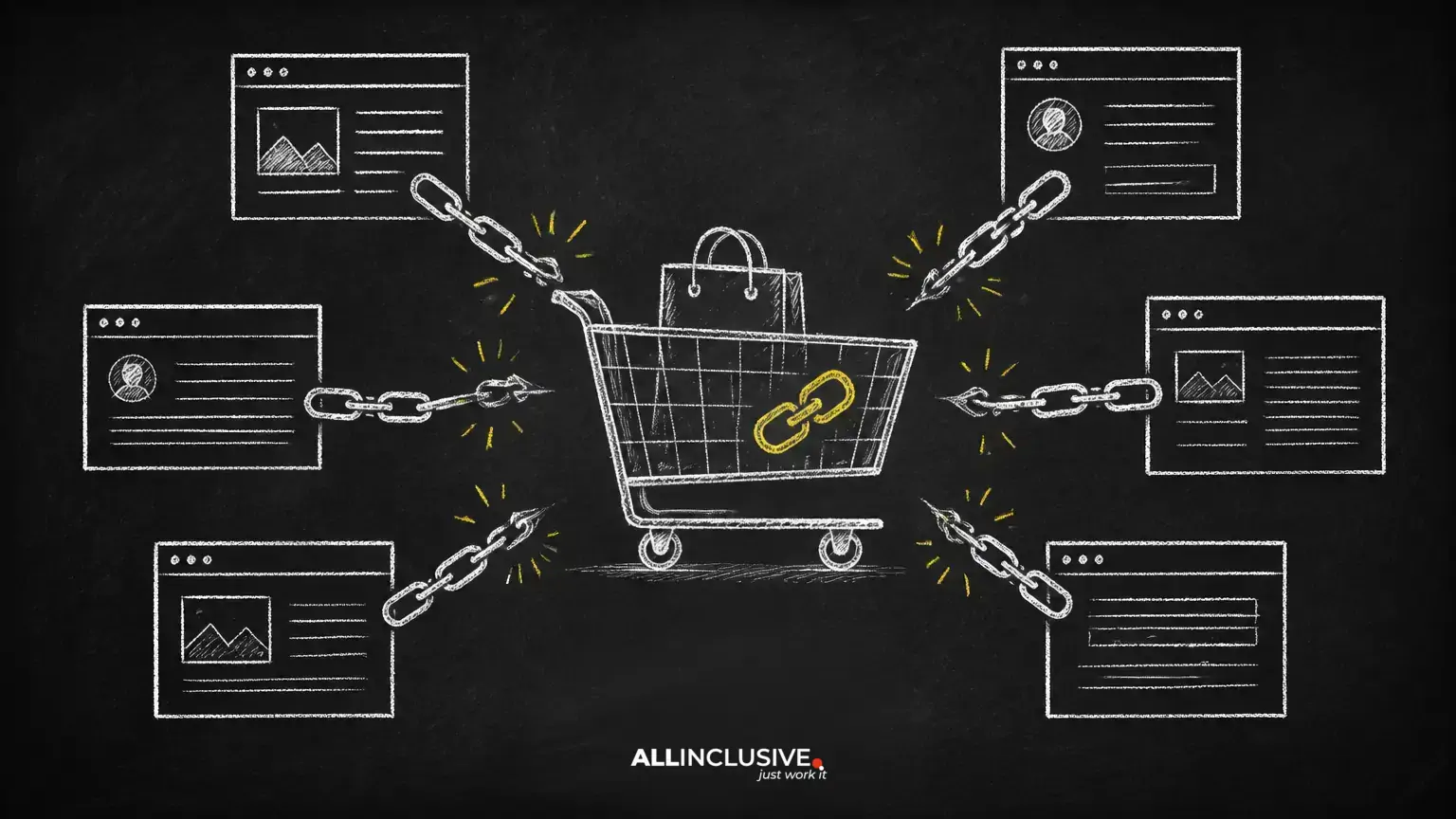
Ecommerce link building is the process of earning relevant links from other websites to product pages, category pages, buying guides, and other useful resources. Done well, it supports discovery, strengthens a site’s reputation, and can bring qualified referral traffic. Done poorly, it creates low-value placements, wasted outreach effort, and avoidable risk.
The strongest ecommerce link-building programs begin with something worth citing. Outreach is important, but it cannot compensate for thin product descriptions, unclear expertise, or a resource that does not help the intended audience. This guide explains how to build an ethical, repeatable process for earning links to an online store.
For broader search strategy, see Allinclusive SEO services and the main link-building pillar.
Why links still matter for ecommerce websites
A link can perform several useful jobs at once. It may introduce a store to a new audience, send referral visitors, help search engines discover a page, and act as a third-party reference to a resource or business. These benefits depend on context. A relevant editorial link from a publication, association, supplier, or specialist community is generally more useful than a large collection of unrelated directory links.
Links are not a substitute for a technically accessible website or useful commercial pages. They work best as part of a wider system that includes sound information architecture, clear product and category content, trustworthy business information, and a good customer experience.
Start with link-worthy assets
Before contacting publishers, decide what you want them to reference. A request to “link to our store” gives an editor little reason to act. A focused asset gives the recipient a clear editorial reason to include a link.
Useful ecommerce assets include:
- Original buying guides: Explain how to compare products, choose specifications, or plan a purchase.
- Practical tools: Offer calculators, sizing assistance, checklists, compatibility guides, or decision frameworks where appropriate.
- Expert explanations: Answer recurring questions with clear definitions, limitations, and examples.
- Product research: Present transparent, reproducible findings when you have a legitimate data source and a defensible method.
- Visual references: Use diagrams, glossaries, timelines, or comparison tables that other writers can cite.
- Original business resources: Publish delivery, care, repair, warranty, or sustainability information that genuinely helps customers.
An asset should serve the reader even if no link is earned. Avoid creating pages solely because a keyword appears attractive. The page should have a clear audience, a specific problem to solve, and information that is not easily replaced by a generic product description.
Choose the right pages for link acquisition
Not every page should be promoted in the same way. Product pages can receive links when a writer is recommending a specific item, but they are often less naturally linkable than educational resources. Category pages may attract links when they represent a useful collection or specialist subject area. Guides and tools are usually better candidates for broad outreach.
Map each potential asset to a realistic purpose:
| Page type | Likely link purpose | Preparation |
|---|---|---|
| Product page | Specific recommendation or product reference | Accurate specifications, availability context, images, and clear purchasing information |
| Category page | Resource list, specialist collection, or shopping reference | Helpful introductory copy, meaningful filters, and stable URLs |
| Buying guide | Educational citation or expert recommendation | Clear methodology, updated explanations, and useful internal references |
| Tool or calculator | Practical reference | Simple instructions, understandable outputs, and accessibility checks |
Use descriptive, natural anchor text when links are earned. The surrounding sentence should explain why the destination is useful. Do not try to control every anchor phrase or ask publishers to repeat an exact commercial keyword.
Find relevant link opportunities
Relevance is more useful than a long prospect list. Build a small set of prospects whose readers could reasonably benefit from the resource. Depending on the ecommerce sector, prospects may include independent publishers, trade organizations, professional communities, complementary businesses, local organizations, educators, event websites, suppliers, and journalists.
Practical prospecting methods
- Study customer questions: Look for websites that already answer the problems your guide addresses.
- Review competitor references: Identify patterns in the types of resources that attract editorial mentions, then create a better or more specific resource rather than copying it.
- Monitor brand and product mentions: A writer may already discuss your business without linking to the relevant page.
- Build partner relationships: Suppliers, manufacturers, installers, associations, and complementary retailers may have legitimate reasons to reference one another.
- Follow sector conversations: Professional newsletters, event pages, and community resources can reveal genuine information gaps.
Qualify each prospect before outreach. Check whether the site is relevant, whether its content appears editorially maintained, whether the proposed page fits the audience, and whether the link would add value. Avoid prospects that exist primarily to sell links or publish unrelated material at scale.
Use outreach as a useful editorial suggestion
Effective outreach is specific, brief, and easy to evaluate. Explain what the resource covers, why it is relevant to that publication’s audience, and where it might improve an existing article. Do not imply that a recipient must link, and do not disguise a paid placement as independent editorial coverage.
A useful outreach message generally includes:
- A personal opening that demonstrates you understand the recipient’s content.
- The specific article, page, or audience need you are addressing.
- A concise description of your resource and what makes it useful.
- A suggested point of relevance, without demanding particular wording or placement.
- A clear way to decline or ignore the message.
One thoughtful follow-up may be reasonable. Repeated messages, automated personalization, and large batches of near-identical emails tend to reduce trust. Keep a record of contacts, responses, placements, and any requested disclosures so your process remains accountable.
Earn links through digital PR and expertise
Digital PR is most effective when you have a real point of view, useful evidence, or an expert who can clarify a topic. Ecommerce businesses can contribute commentary on product selection, maintenance, materials, safety, accessibility, seasonal preparation, or common buyer mistakes—provided the claims are accurate and within the speaker’s expertise.
Prepare a small media resource containing:
- A concise description of the business and relevant expertise.
- Clear answers to common questions.
- Supporting documentation for factual claims.
- High-quality images or diagrams that you have permission to provide.
- Contact details and any required disclosures.
Do not manufacture survey results, trends, expert credentials, or news angles. If a journalist uses your contribution, the resulting link may point to a useful guide or an appropriate business page, but the primary goal should be helping the audience.
Use link reclamation carefully
Link reclamation looks for existing mentions or references that could be improved. Common examples include an unlinked brand mention, a link pointing to a removed URL, a broken link to an older guide, or a product reference that now has a more useful destination.
Verify the opportunity before contacting anyone. The mention should be genuine, the proposed destination should match the surrounding context, and the request should not pressure the publisher to make an editorial change. If a URL has moved, implement an appropriate redirect and maintain the replacement page rather than asking every historical publisher to update immediately.
Build links through relationships and partnerships
Long-term relationships can create legitimate opportunities that one-off campaigns cannot. Consider co-created educational resources, supplier documentation, events, professional memberships, community initiatives, and expert contributions. The relationship should exist independently of the link. A link is a useful by-product of collaboration, not the sole reason to create it.
Be transparent about commercial relationships. Paid sponsorships, gifted products, affiliate arrangements, and contributed content may require disclosure and appropriate link attributes under applicable policies. Confirm current platform and regulatory requirements before publishing or requesting a placement.
Measure quality instead of link volume
A link-building report should connect activity to business value. Track metrics that help you make decisions, such as:
- Relevant referring domains and the pages that earned their attention.
- Referral visits and meaningful actions from those visitors.
- Growth in visibility for important informational and commercial topics.
- Conversions or assisted conversions where reliable attribution is available.
- Outreach response rates, qualified conversations, and content production costs.
- Broken links, lost links, and redirects requiring review.
Third-party authority scores can help organize research, but they are not universal measurements of ranking value. Do not judge a campaign only by the number of links or by a single proprietary score. A smaller number of relevant references may be more useful than a large volume of low-context placements.
Practices to avoid
- Buying links intended to manipulate rankings.
- Automated comments, forum drops, or mass directory submissions.
- Private networks created mainly to pass ranking signals.
- Low-quality guest posts produced only to place keyword-rich anchors.
- Exchanging links at scale without a genuine editorial reason.
- Creating statistics or research findings without a defensible source and method.
- Using irrelevant publications because they advertise high authority metrics.
When evaluating a tactic, ask whether a reasonable editor would include the link if search engines did not exist. If the answer is no, the tactic probably needs to be redesigned around audience value or abandoned.
A practical 90-day workflow
- Weeks 1–2: Review existing content, technical accessibility, internal linking, brand mentions, and lost or broken links.
- Weeks 3–4: Select one or two link-worthy assets and improve their evidence, usability, design, and internal connections.
- Weeks 5–8: Build a qualified prospect list and conduct personalized outreach to the most relevant contacts.
- Weeks 9–12: Follow up selectively, support legitimate PR opportunities, document placements, and assess referral and search outcomes.
Repeat the cycle with better prioritization. The aim is not continuous outreach for its own sake; it is a growing library of useful resources and credible relationships.
Conclusion
Sustainable ecommerce link building is an editorial and relationship discipline. Create resources worth citing, select prospects whose audiences genuinely match, make concise and transparent suggestions, and measure relevance and business impact rather than raw link totals. When the underlying site and content deserve attention, earned links can support both users and long-term search visibility.