
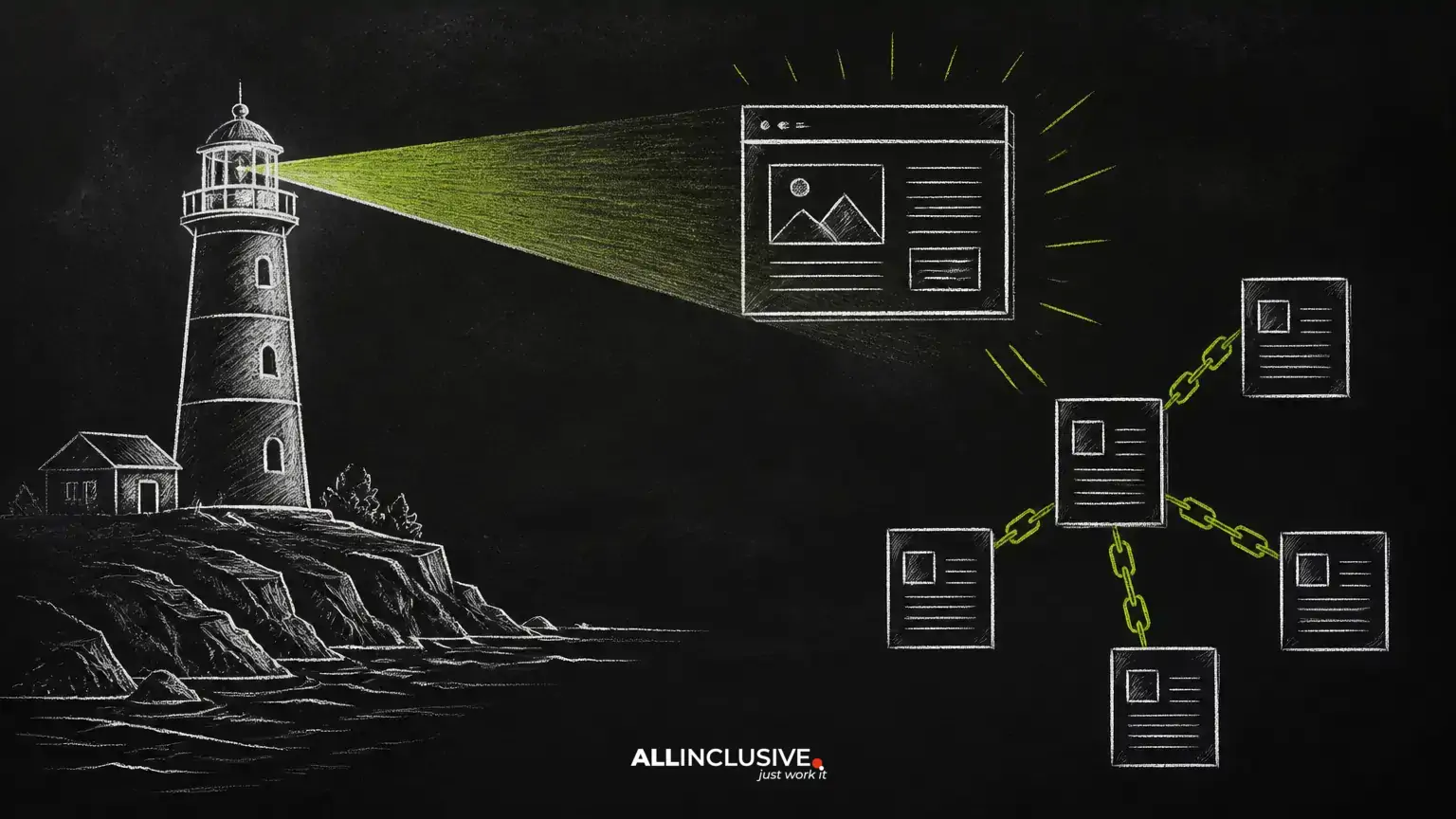
Search visibility rarely improves because of one isolated change. A new article, revised title tag, or additional backlink may help, but durable progress usually comes from making a website easier to understand and more useful to the people it serves.
That means connecting three disciplines: content strategy, on-page optimization, and information architecture. When these elements support one another, search engines can more clearly identify a page’s purpose, while visitors can find the next useful answer with less friction.
This guide presents a practical framework for improving search visibility without relying on inflated promises, arbitrary content quotas, or tactics designed only to manipulate rankings. For broader planning and execution, see the Allinclusive content marketing pillar.
Start with the search journey, not a keyword list
Keyword research is useful, but a list of phrases is not a content strategy. Before creating or revising pages, identify what a prospective customer is trying to accomplish and where they are in the decision process.
A basic search journey may include:
- Problem awareness: The visitor is defining a challenge and looking for explanations.
- Option discovery: The visitor is comparing approaches, providers, tools, or solutions.
- Evaluation: The visitor needs evidence, requirements, costs, limitations, or implementation details.
- Action: The visitor is ready to contact a provider, request information, or complete a transaction.
Each stage may deserve a different page type. An educational guide should not be forced to behave like a sales landing page, and a service page should not be overloaded with unrelated definitions. Mapping intent first helps prevent keyword cannibalization and gives every important page a distinct job.
Audit existing content before publishing more
Many websites have more opportunity in their existing pages than in a large batch of new articles. Begin with an inventory that records each URL, its topic, audience, intent, business value, organic performance, conversion role, and most likely action.
Classify pages into practical groups:
- Keep and improve: The page serves a valuable intent but needs clearer structure, stronger evidence, better examples, or improved calls to action.
- Consolidate: Several pages address substantially the same need and divide attention or create competing signals.
- Redirect or retire: The page is obsolete, duplicative, empty, or disconnected from current business goals.
- Create: A meaningful audience need is not addressed by any existing page.
Do not remove content simply because it has low traffic. A page can support sales, answer a specialized question, assist existing customers, or strengthen a topic cluster without attracting large volumes of visitors. Judge it against its purpose, not one metric.
Improve pages by making the answer clearer
Content improvement is not the same as adding words. A stronger page gives the reader a more complete and usable answer than the alternatives available to them.
Clarify the primary question
State the page’s subject early. The introduction should establish who the page is for, what it explains, and what the reader will be able to do or understand afterward. Avoid opening with a long history of the topic or a vague promise.
Build a useful structure
Use descriptive headings that reflect the reader’s questions. Break complex subjects into logical sections, explain specialist terms, and place important qualifications near the claims they qualify. Lists, tables, examples, and step-by-step instructions can make information easier to apply.
Add original usefulness
Useful differentiation may come from a decision framework, a worked example, a checklist, a comparison, a calculator, implementation guidance, or a clear explanation of trade-offs. Originality does not require sensational opinions; it requires helping the reader make progress.
Handle high-stakes topics carefully
For financial, legal, medical, safety, or other consequential subjects, distinguish general information from professional advice. Identify assumptions, explain limitations, and review claims that may change over time. Do not present outdated details as current.
Use on-page signals accurately
On-page elements help describe a page, but they cannot compensate for an unclear or unhelpful resource. Review them after the page’s purpose and content are settled.
- Title: Describe the page’s specific subject in a concise, natural way.
- Meta description: Set an honest expectation about what the page contains. It can influence the decision to click, but it is not a substitute for relevance.
- Headings: Organize the document for scanning and comprehension. Do not use headings merely to repeat variations of a phrase.
- URL: Keep it readable, stable, and aligned with the page’s topic. Changing a URL solely to place a phrase earlier in the path can introduce unnecessary migration risk.
- Images: Use descriptive alternative text when an image conveys information. Decorative images generally do not need verbose descriptions.
After edits, check that the visible page, title, structured headings, and navigation all communicate the same intent. Consistency is more valuable than mechanical repetition.
Design internal linking as a navigation system
Internal links help people discover related information and help search engines understand how pages relate to one another. They work best when they are placed where a reader would naturally want more detail.
Link from broad topics to specific answers
A central guide can link to detailed explanations, comparisons, definitions, and service pages. Those detailed pages can link back to the broader guide when the relationship is genuinely useful. This creates a coherent path rather than a collection of isolated posts.
Use descriptive anchor text
Anchor text should explain what the linked page offers. “Learn more” provides little context; “content marketing strategy” is more informative when that is the actual subject of the destination. Keep wording natural and vary it when appropriate.
Prioritize important pages without forcing links
Review navigation, category pages, resource hubs, and high-traffic articles to identify sensible linking opportunities. Do not add links to every possible page. Excessive or irrelevant linking makes pages harder to use and weakens the information hierarchy.
For organizations planning broader search improvements, the SEO services overview provides a useful companion to a content-led approach.
Create a topic map before expanding the site
A topic map connects audience needs to page types and business goals. It should show the main pillar topic, supporting questions, commercial pages, and the links that connect them.
For each planned page, document:
- The primary audience and search intent.
- The unique question or task the page addresses.
- Existing pages that overlap with the topic.
- Evidence, examples, or expertise needed to make the page useful.
- Relevant internal links into and out of the page.
- The action or next step that is appropriate for the reader.
This process exposes gaps without treating every keyword variation as a separate article. Similar queries can often be handled by one comprehensive resource, while genuinely different intents may require separate pages.
Measure progress beyond rankings
Rankings fluctuate by location, device, personalization, competition, and search features. Use them as one diagnostic signal rather than as the only definition of success.
A balanced measurement set may include:
- Organic impressions and clicks for relevant queries.
- Engagement with the page’s primary task or call to action.
- Qualified leads, assisted conversions, or sales where tracking is reliable.
- Internal-link clicks and movement between related pages.
- Indexing and crawl issues discovered during technical reviews.
- Performance by page type, topic, audience, and intent.
Establish a baseline before major changes, record what changed, and allow enough time for interpretation. Avoid attributing every movement to one edit when multiple variables changed together.
Common mistakes to avoid
- Publishing at any cost: More URLs do not automatically create more visibility. Quality, relevance, and maintenance matter.
- Copying competitors: Competitor pages can reveal unanswered questions, but imitation does not create distinctive value.
- Over-optimizing language: Repeating phrases unnaturally harms clarity and can make a page feel untrustworthy.
- Changing architecture casually: URL and navigation changes can affect users, links, indexing, and redirects. Plan and document them.
- Treating internal links as decoration: Links should support a reader’s next step, not exist only to distribute phrases.
- Promising a fixed timeline: Search performance depends on the site, topic, competition, technical health, and implementation quality. Use measured expectations.
A practical improvement workflow
- Inventory: Export or document important URLs, page purposes, performance, and ownership.
- Diagnose: Identify overlap, missing intents, weak introductions, outdated claims, technical barriers, and poor navigation paths.
- Prioritize: Start with pages that combine meaningful audience demand, business value, and a realistic opportunity to improve.
- Revise: Improve the answer, structure, evidence, metadata, accessibility, and calls to action.
- Connect: Add relevant internal links from appropriate hubs and related pages.
- Validate: Check redirects, canonical signals, rendering, mobile usability, links, forms, and analytics.
- Learn: Review performance and user behavior, then update the plan based on evidence rather than assumptions.
Conclusion
Improving search visibility is a systems problem. Useful content attracts and assists the right audience; clear page signals explain the resource; and internal linking connects individual answers into a navigable body of knowledge.
The most reliable approach is to audit what already exists, assign each page a distinct purpose, improve substance before optimizing wording, and measure outcomes that matter to both users and the organization. That work may be less dramatic than a single ranking claim, but it creates a stronger foundation for sustained discovery.