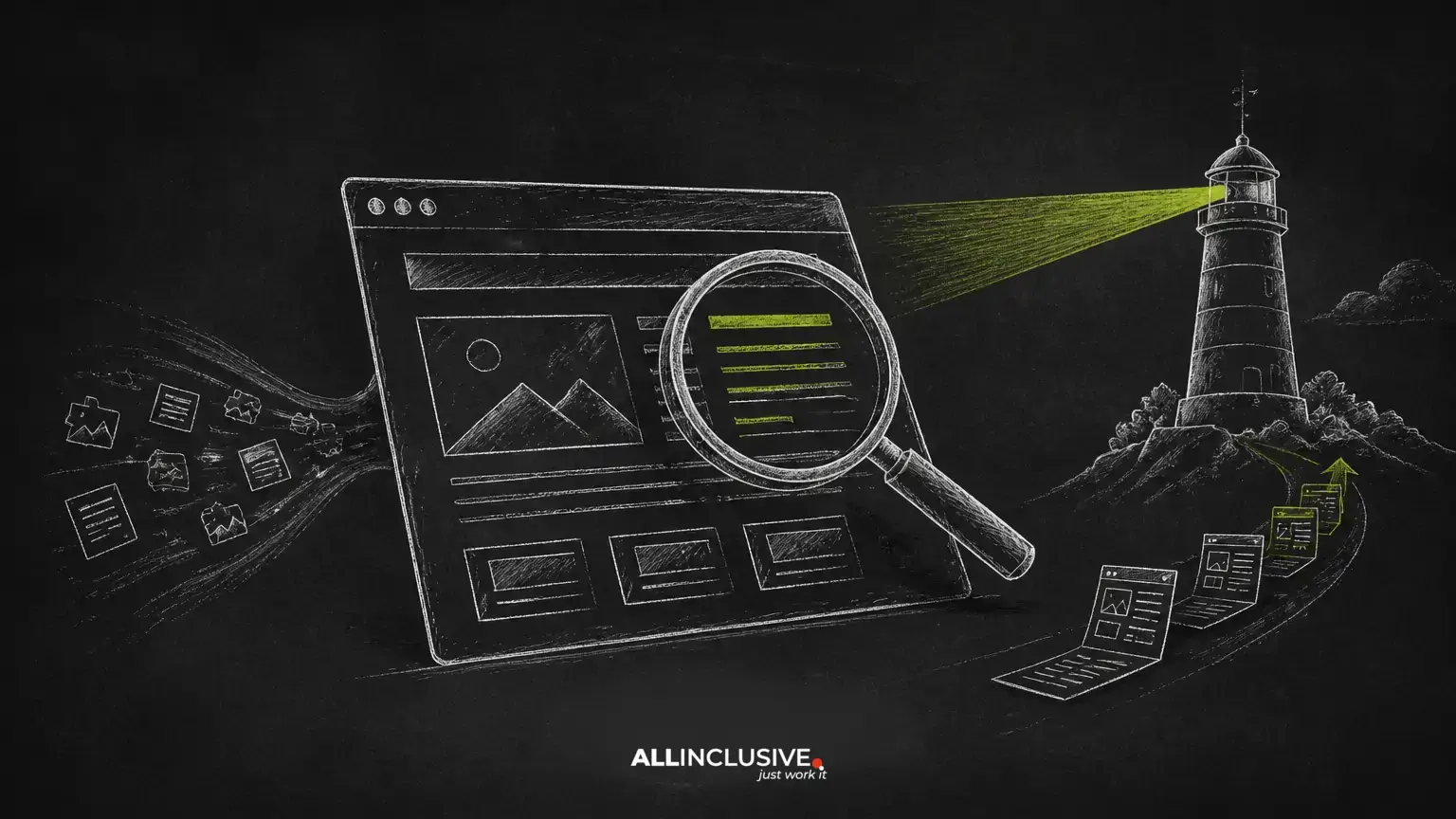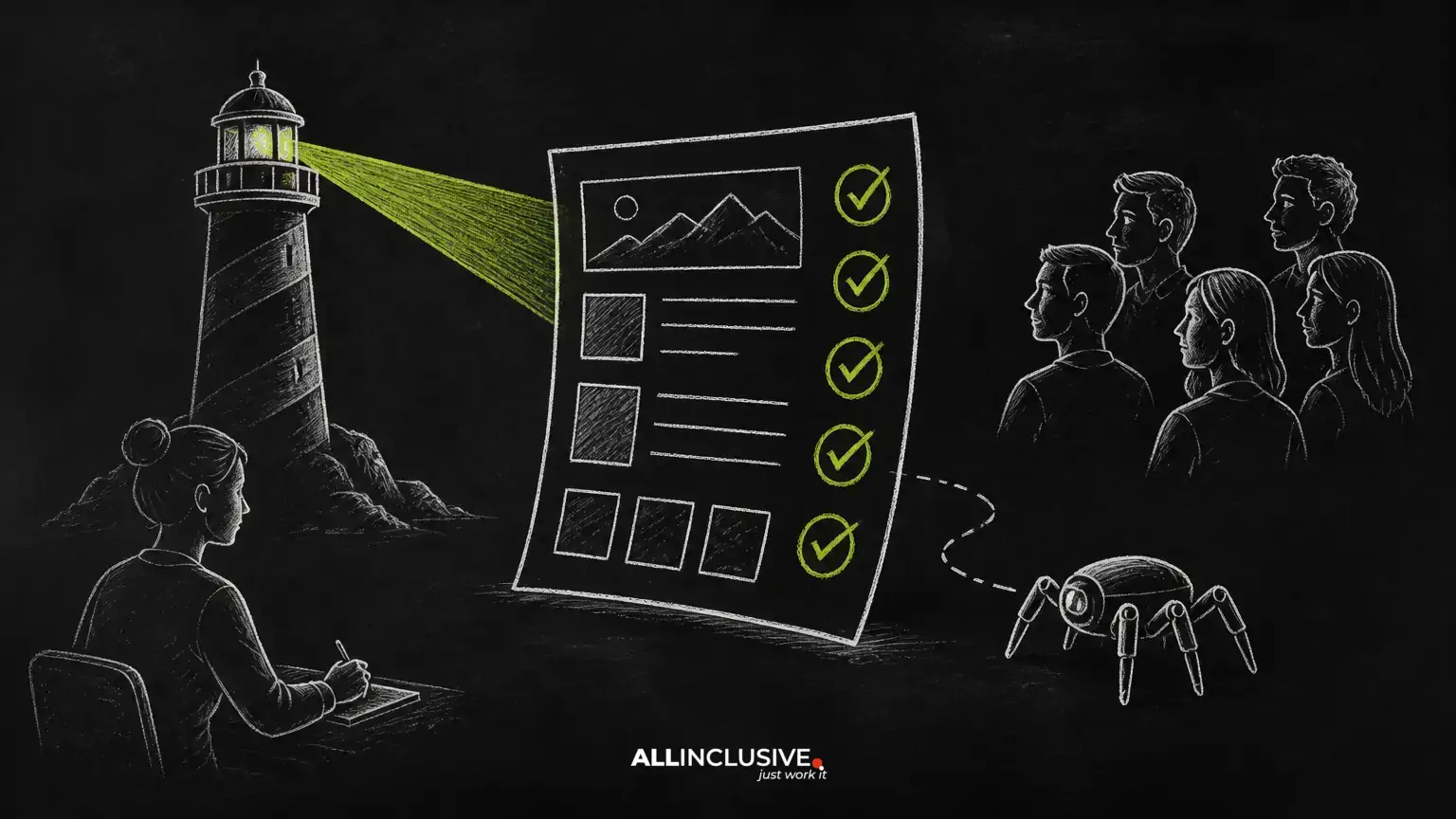
SEO copywriting is the practice of creating web content that helps people find answers, make decisions, or take action through search. It combines audience research, search-intent analysis, clear writing, page structure, and thoughtful optimization. A practical framework for identifying search intent can help turn these principles into stronger content decisions.
The goal is not to write for an algorithm instead of a person. The goal is to make the page easy for both readers and search systems to understand. A strong page answers the main question promptly, covers important related concerns, demonstrates appropriate expertise, and gives the visitor a logical next step.
This guide presents a practical workflow for planning, writing, publishing, and improving SEO-focused content. For the broader role of content in organic growth, see Allinclusive’s content marketing services.
What makes SEO copywriting different?
Traditional copywriting often emphasizes persuasion, while editorial writing may emphasize explanation or reporting. SEO copywriting can include both, but it begins with a discoverability problem: what does the audience search for, and what kind of answer are they expecting?
A useful SEO page usually does four things:
- Matches a clearly defined search intent.
- Explains the topic accurately and at the appropriate depth.
- Uses headings, examples, and formatting that support scanning.
- Connects the reader to a relevant next action or resource.
Keywords help describe the topic, but they are not a substitute for relevance. Repeating a phrase unnaturally can make a page harder to read and may obscure the answer the visitor came to find.
Start with the audience and the page’s job
Before researching phrases or drafting an outline, define who the page is for and what it should accomplish. A beginner seeking a definition needs a different explanation from a specialist comparing implementation options. A service page also has a different job from a tutorial.
Write a short brief that answers:
- Who is the intended reader?
- What problem or decision brought them to search?
- What should they understand by the end?
- What action is appropriate after they have that understanding?
- What evidence, examples, or limitations will make the answer credible?
This prevents a common failure mode: creating a page that targets a broad phrase but does not satisfy the people who arrive through it.
Research topics and search intent
Use a primary topic, not a keyword list
Choose one central topic for the page and collect related language around it. Related terms may include synonyms, subtopics, questions, comparisons, definitions, and practical constraints. The purpose is to understand the subject’s vocabulary and the reader’s concerns, not to force every variation into the copy.
Identify the expected type of answer
Search intent is the underlying purpose of a query. It is often useful to classify it as:
- Informational: the searcher wants an explanation, definition, or process.
- Commercial investigation: the searcher is comparing options or evaluating solutions.
- Transactional: the searcher is ready to buy, book, sign up, or otherwise act.
- Navigational: the searcher is trying to reach a particular site, brand, or page.
These categories can overlap. Treat them as planning aids rather than rigid labels. Review the wording of the query and the format of pages that appear for it. If people expect a comparison, a general essay may disappoint. If they expect a step-by-step process, a sales pitch may be premature.
Build an outline around questions
A useful outline follows the reader’s path through the problem. Start with the direct answer or a concise orientation, then address the questions that naturally follow.
- State what the topic means or what the process achieves.
- Explain why it matters and who should use it.
- Present the main steps or decision points.
- Cover common mistakes, limitations, or exceptions.
- Provide examples that make the advice concrete.
- Offer a relevant next step.
Use headings that describe the section’s actual benefit or question. “How to choose a content brief structure” is more useful than a vague heading such as “Best practices.” Headings should create a visible outline for someone scanning the page.
Write the answer before optimizing the wording
Draft the most important answer first. Do not make readers search through a long introduction for the information promised by the title. A concise opening can establish the definition, recommendation, or result before the page expands into detail.
Good SEO copy is usually:
- Specific: it explains what to do, not merely that something is important.
- Readable: it favors familiar words and explains necessary technical terms.
- Structured: it groups related ideas into sections and lists.
- Qualified: it identifies when advice depends on context.
- Actionable: it gives the reader a practical way to apply the information.
Short paragraphs can help scanning, but brevity should not remove necessary nuance. Some subjects require detailed explanations, examples, tables, or step-by-step instructions. Optimize for comprehension rather than an arbitrary word count.
Use keywords naturally and precisely
Include the language that accurately describes the page in important places such as the title, opening, relevant headings, and body copy. Then write naturally. Use variations where they improve clarity, and remove repetition that sounds artificial.
Ask these questions during editing:
- Does the page clearly communicate its topic without repeated phrases?
- Would a reader understand the terminology if they were unfamiliar with the subject?
- Does each section answer a real question or support the page’s purpose?
- Have related terms been included because they are useful, rather than because they were collected in research?
Do not make unsupported promises about rankings, traffic, or conversions. Search visibility depends on many factors, including competition, site quality, technical accessibility, reputation, and changing search behavior. If you need a wider optimization program, review the SEO services overview.
Make the page easy to scan
Many visitors scan before committing to a full read. Help them find the right section quickly through a logical heading hierarchy, informative subheadings, lists, tables, and descriptive links.
Prefer one main idea per paragraph. Put the key point near the beginning, then provide explanation or evidence. Use numbered lists for sequences and bullet lists for grouped items. Use a table only when it makes comparisons easier than prose.
Read the draft aloud or edit it in passes. One pass can address accuracy, another structure, and another sentence clarity. Separating these tasks makes it easier to find both factual gaps and awkward writing.
Add evidence without inventing authority
Useful content earns trust through accurate explanations, relevant experience, transparent assumptions, and appropriate evidence. If you use statistics, quotations, research findings, or claims about current products and policies, verify them before publication and cite the original authoritative source.
When no reliable evidence is available, use careful wording. Explain what is generally true, distinguish recommendations from facts, and acknowledge uncertainty. Never create a case study, performance result, customer story, or industry statistic to make a page sound more persuasive.
Examples are still valuable when they are clearly presented as examples. For instance, a hypothetical content brief can show how a team might define an audience, intent, outline, and call to action without implying that the scenario represents actual results.
Plan internal links as part of the reader journey
Internal links should help visitors move from the current question to a closely related next question. Link from descriptive, natural anchor text and ensure the destination delivers what the anchor promises.
For an informational SEO copywriting article, useful destinations may include a broader content strategy resource, a service explanation, a related technical guide, or a contact path. Avoid adding links merely to increase the number of links. Every link should clarify the site’s information architecture or help the reader act.
Review links after publication. Remove broken destinations, update anchors when the context changes, and check that important pages are not isolated from the rest of the site.
Write metadata and calls to action that match the page
The title tag and meta description should accurately preview the page. They are not a place for exaggerated claims or promises the article cannot fulfill. A clear title explains the subject, while a useful description summarizes the benefit of reading.
Calls to action should match intent. An informational visitor may be ready for a related guide or checklist rather than an immediate sales request. A commercial visitor may need a comparison, service detail, or consultation option. Use one primary next step and support it with relevant contextual links.
Review the draft before publishing
Use a repeatable quality check:
- Confirm that the page has one clear purpose and a defined audience.
- Check that the opening answers or frames the main query quickly.
- Compare every major section with the searcher’s likely follow-up questions.
- Remove unsupported claims, stale references, and unnecessary repetition.
- Check headings, lists, links, images, and descriptive text for accessibility and clarity.
- Review the page on mobile and test every important link.
- Confirm that the title, description, and call to action match the actual content.
Publication is not the end of the process. Once a page has enough performance and feedback data to review, look for unanswered questions, declining relevance, confusing sections, and opportunities to link it from related pages. Update substance, not just wording.
Common SEO copywriting mistakes
- Writing for a phrase instead of a person: the copy sounds repetitive and fails to address the real problem.
- Copying the apparent structure of competing pages: the result adds little original value.
- Chasing length: extra paragraphs create friction without improving the answer.
- Using vague advice: readers need examples, criteria, and practical steps.
- Overpromising outcomes: claims about rankings or revenue need evidence and context.
- Ending without a next step: the reader receives information but no useful path forward.
Conclusion
SEO copywriting works best as a user-centered editorial process. Understand the audience, identify the intent behind the query, organize the answer around real questions, write with precision, and connect the page to a relevant next action. Optimization should make a useful page easier to discover and understand—not disguise thin or unsupported content.