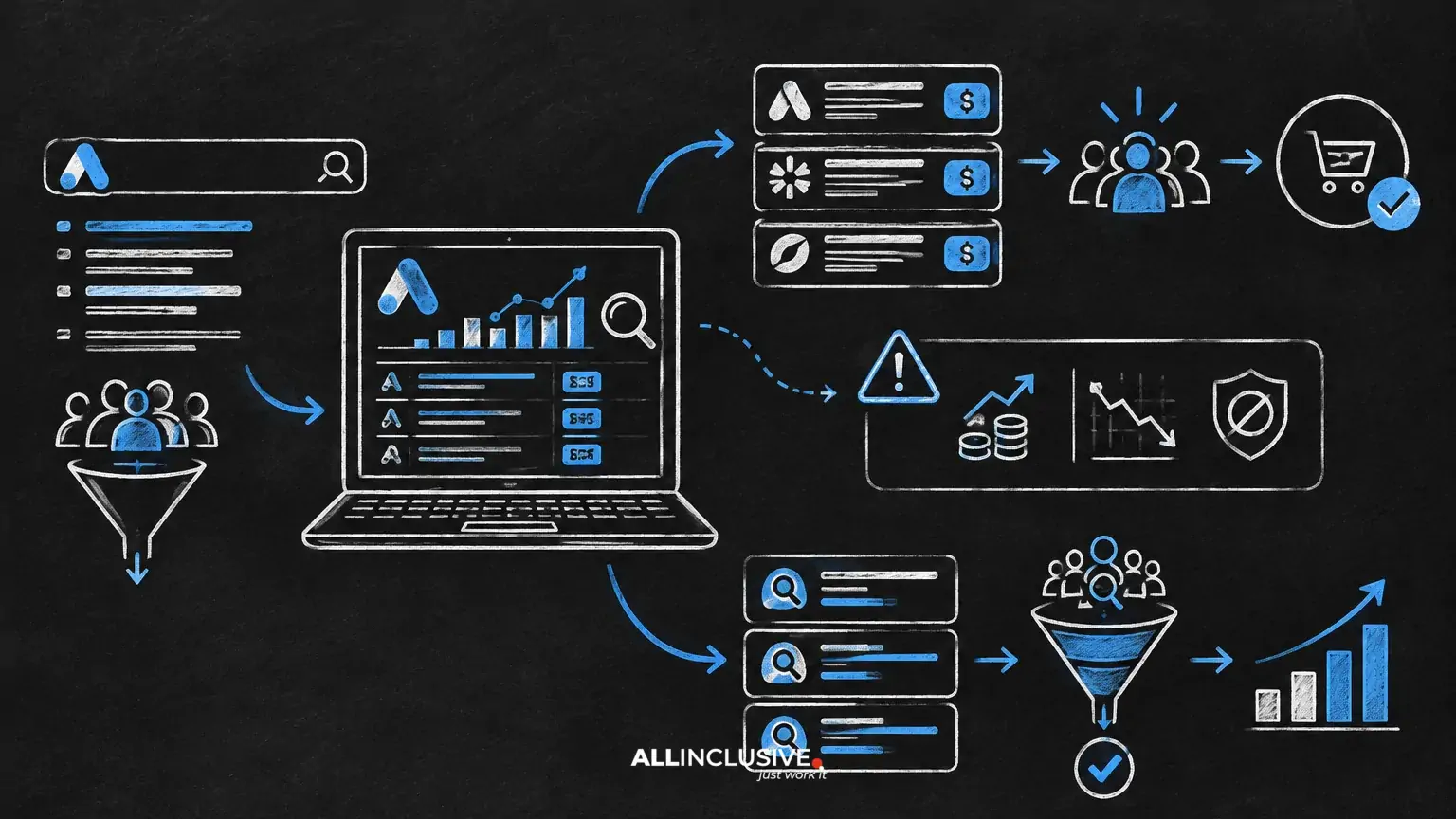
Competitor keyword bidding in Google Ads can put your offer in front of people already comparing providers, but it is not a shortcut to efficient growth. Competitor searches often signal high intent, yet they also bring trademark considerations, weaker message alignment, lower conversion quality, and potential escalation from other advertisers.
The right question is not simply whether you can bid on a competitor’s name. It is whether the incremental, qualified pipeline or revenue justifies the cost and operational risk compared with non-brand search, your own brand campaigns, or category-focused alternatives.
What competitor bidding means in Google Ads
Competitor bidding is the practice of targeting search queries that include another company’s name, product, service, or branded terminology. A B2B software company might target searches for an established platform when prospects are evaluating alternatives. An agency might target a rival’s brand alongside terms such as “alternative,” “pricing,” or “reviews.”
This is different from using a competitor’s name in ad copy or landing-page content. Keyword targeting, ad text, landing-page claims, and trademark treatment are separate considerations. Platform policies and applicable law can vary by market and change over time, so have qualified legal counsel review sensitive campaigns rather than treating a keyword strategy as a legal conclusion.
When competitor bidding can make strategic sense
Competitor campaigns are most defensible when your product has a clear reason to be considered by the same audience. That reason might be a materially different implementation model, a specific integration, a lower-complexity workflow, stronger support for a use case, or a credible migration path.
Before launching, confirm that the campaign satisfies four conditions:
- Audience overlap: People searching for the competitor are plausibly within your target market, not merely curious about a well-known brand.
- Meaningful differentiation: Your offer addresses a recognizable weakness, use case, or switching trigger.
- Commercial readiness: Your sales and onboarding teams can handle prospects comparing you directly with an incumbent.
- Measurement discipline: You can separate competitor traffic, qualified conversions, opportunities, and revenue from broader search performance.
If these conditions are absent, competitor bidding often becomes expensive comparison traffic without a compelling reason to choose you.
The main risks to evaluate
Trademark and policy exposure
Trademark treatment differs across jurisdictions and advertising contexts. A brand name may be used as a targeting signal in some circumstances while creating issues when used in ad copy, comparative claims, or landing-page content. Do not assume that an ad approval or lack of an immediate complaint means the approach is universally permissible.
Maintain a documented review process for competitor terms, ad language, claims, and destination pages. Avoid implying affiliation, endorsement, or ownership. Comparative statements should be specific, supportable, and reviewed for the markets in which they will run.
Low relevance and expensive clicks
A person searching for a competitor may want that competitor’s login page, support documentation, pricing, or existing product. Your ad can attract attention without creating genuine buying intent. This can produce clicks that look valuable in the account but fail to become qualified opportunities.
Use search-term analysis and downstream conversion data to distinguish active evaluation from navigational or support-related searches. Do not judge the campaign solely on click-through rate or initial lead volume.
Message escalation
Competitor campaigns can invite direct responses from the brands you target. Even when that response is legal and permitted, it may increase auction pressure and raise costs for both sides. The campaign should therefore have a clear economic ceiling rather than an open-ended goal of winning every auction.
Brand confusion and trust issues
Ambiguous copy can make users think your company is connected to the competitor. That may create poor-quality leads, complaints, or a damaged first impression. Clear identity and honest positioning are more valuable than a vague attempt to borrow recognition.
How to structure a competitor campaign
Start with a narrow test built around intent, not a large list of every rival and product variation. Separate competitors into groups based on the reason a prospect might switch:
- Alternative searches: Queries that explicitly seek another option.
- Comparison searches: Queries that compare two providers or products.
- Commercial evaluation: Brand-plus-pricing, implementation, demo, migration, or review terms.
- Navigational and support searches: Queries likely to be existing-user activity, which usually require exclusion or close monitoring.
Keep competitor themes separated where practical. This makes it easier to compare cost, engagement, lead quality, and sales outcomes by rival and intent type. It also prevents one high-volume competitor from hiding poor performance elsewhere.
Use controlled keyword coverage
Begin with terms that reveal active evaluation, such as “alternative,” “versus,” “competitor,” “pricing,” or “switching,” when they accurately reflect the searcher’s intent. Broadly targeting every query containing a competitor name can expand into research, support, employment, and unrelated searches.
Review search terms frequently during the initial test. Build exclusions for jobs, login, support, documentation, free downloads, customer service, and other irrelevant themes when they appear. The appropriate exclusions depend on your market and product, so use actual query data rather than a generic list alone.
Write clear, non-deceptive ads
Ads should identify your company and explain why the searcher might consider it. Strong messages focus on a verifiable benefit or use case:
- “A simpler implementation path for distributed finance teams”
- “Compare workflow options for regulated operations”
- “Move from spreadsheets to a managed approval process”
These examples are positioning directions, not claims to publish without validation. Avoid unsupported superlatives, unverified savings, or language that suggests you are the competitor. If you mention another brand in copy, obtain an appropriate review before launch.
Match the landing page to the comparison intent
Sending competitor traffic to a generic homepage usually creates unnecessary friction. Use a landing page that explains your category, ideal customer, relevant differences, implementation considerations, and next step. A comparison page can be useful when it is factual, current, and transparent about the basis of comparison.
Do not create a page that copies a competitor’s branding or makes claims your sales team cannot support. Include proof that is relevant to the buying decision, such as product details, integrations, security information, service model, or migration guidance where applicable.
Measurement: evaluate business value, not borrowed attention
Competitor campaigns need a stricter measurement framework than ordinary search campaigns because the traffic may be curious, defensive, or comparison-driven. Track performance at several stages:
- Traffic quality: Search terms, engagement signals, geography, device, and landing-page behavior.
- Conversion quality: Form completeness, booked meetings, trial activation, qualified calls, or another meaningful action.
- Pipeline progression: Accepted opportunities, sales-stage movement, and disqualification reasons.
- Economic outcome: Revenue, gross margin, customer acquisition cost, and payback where your data supports those calculations.
Use consistent definitions across campaigns. A competitor lead should not count as a success merely because a form was submitted. If the sales cycle is long, create interim indicators but keep them connected to later-stage outcomes.
Compare the campaign with relevant alternatives rather than with an account-wide average. A non-brand campaign targeting a category problem may generate fewer clicks but more scalable qualified demand. Your non-brand search strategy should be part of the control group when you assess incremental value.
Alternatives to competitor bidding
Own the category problem
Category and pain-point searches often reach prospects before they form a preference for a particular provider. Terms tied to a business problem, workflow, use case, or required capability can offer broader reach without directly intercepting a competitor’s brand demand.
This approach requires stronger qualification and message discipline, because the audience may be earlier in its evaluation. It can also create a more durable acquisition channel when your value proposition is tied to the problem rather than to a rival’s recognition.
Strengthen your own brand campaigns
Protecting your brand demand can be more efficient than pursuing another company’s branded audience. Brand campaigns help capture users who already know your company and can support clean measurement of existing demand. They should not be treated as proof that all other campaigns are working, however.
For a deeper decision framework, see when brand campaigns in Google Ads make sense.
Build comparison and switching content organically and through paid distribution
People evaluating alternatives need answers about migration, integrations, implementation effort, total cost, support, and fit. A useful comparison resource can serve paid search, sales enablement, remarketing, and organic discovery. Its value comes from helping buyers make a decision, not from repeating a competitor’s name as often as possible.
Improve high-intent campaigns you already control
Before adding competitor terms, review existing campaigns for coverage gaps around pricing, demos, implementation, use cases, and urgent problems. For companies with complex sales cycles, the issue may be lead qualification or conversion tracking rather than insufficient keyword reach. The broader paid search strategy should establish these fundamentals first.
A practical go-or-no-go framework
Use the following questions before approving a test:
- Can we explain in one sentence why a competitor’s customer should consider us?
- Do we have evidence that the audience and use case overlap?
- Can we publish accurate comparison or switching content?
- Has the proposed targeting and copy received the necessary policy and legal review?
- Can we identify qualified outcomes beyond leads?
- What is the maximum acceptable cost for an opportunity or customer?
- What would cause us to pause the test?
Set the budget and evaluation window according to your sales cycle and conversion volume. Do not force a fast conclusion from insufficient data, but do not continue indefinitely because the campaign produces attractive click metrics.
How to decide whether competitor bidding is right for you
Competitor keyword bidding is best treated as a controlled acquisition experiment, not a default account structure. It can be appropriate when your differentiation is clear, the audience is commercially relevant, your claims are supportable, and your measurement reaches qualified pipeline or revenue.
It is usually a poor first move when your brand is unknown, your landing page lacks comparison content, your conversion tracking stops at form fills, or your offer does not provide a credible reason to switch. In those cases, invest first in category demand, your own brand presence, conversion quality, and the fundamentals covered in a broader paid media strategy.
The strongest approach is often a portfolio: protect existing demand, capture category and problem-based searches, and test a narrow set of competitor terms only where the economics and customer fit are clear.