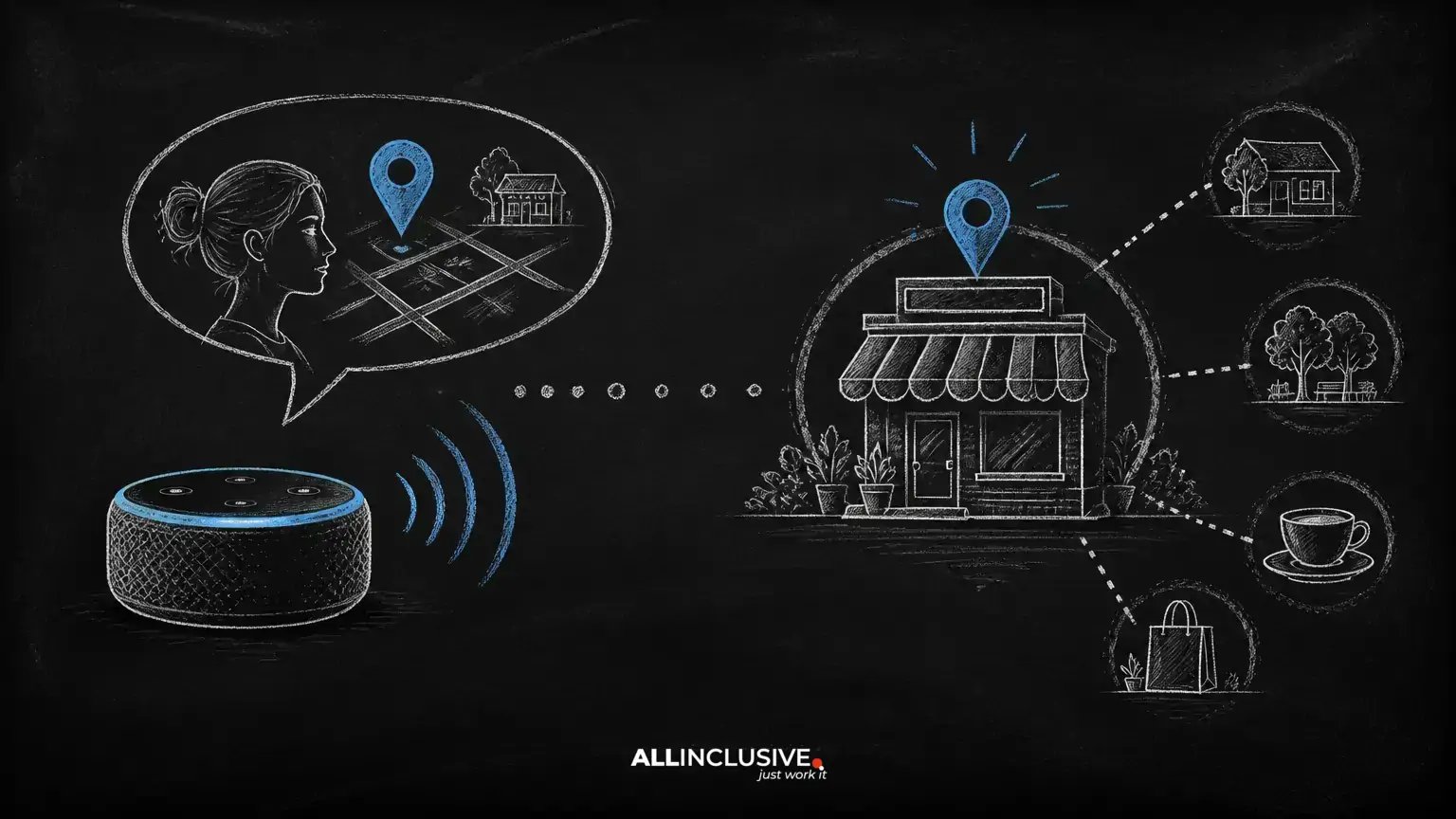
People often use voice interfaces differently from typed search. Instead of entering a short phrase such as plumber Denver, a customer may ask, “Who can fix a leaking pipe near me?” or “Is there a dentist open today?” These questions reveal a local need, a possible service, and sometimes an immediate constraint such as distance, availability, or opening hours.
Voice search optimization is therefore best understood as an extension of strong local SEO, not as a separate trick or guaranteed ranking channel. Assistants may use search engines, map platforms, business directories, device context, and structured business information in different ways. Because those systems and interfaces can change, businesses should focus on information that is accurate, accessible, and genuinely useful.
For a broader foundation, see the Allinclusive local SEO pillar. The following framework focuses specifically on conversational local discovery.
What voice search means for local businesses
Voice interactions commonly fall into several local-intent groups:
- Discovery: “Find a roofing contractor near me.”
- Evaluation: “What is the best-rated Italian restaurant nearby?”
- Action: “Call the closest auto repair shop.”
- Visit planning: “What time does the pharmacy close?”
- Directions: “How do I get to the nearest urgent care?”
The wording is conversational, but the underlying requirements are familiar. Search systems need to understand what the business offers, where it serves customers, whether its information is trustworthy, and whether the result fits the query’s context. A business that treats voice search as a reason to publish awkward keyword variations will usually create poorer content without solving those underlying needs.
Build a reliable local information base
Voice results depend on data that systems can interpret confidently. Start by reviewing every important business detail across the sources customers may use to discover or evaluate you.
Keep core details consistent
Use a consistent real-world business name, address, phone number, website, category, and hours. Resolve differences such as abbreviated street names, outdated phone numbers, duplicate profiles, and old locations. If the business serves customers at their locations and does not receive visitors at a storefront, describe the service area accurately rather than publishing an address that customers cannot visit.
Maintain special hours and service details
Regular opening hours may not answer questions about holidays, appointments, emergency service, delivery, accessibility, parking, or last orders. Keep these details current wherever the platform supports them, and make important information visible on the website as well. Avoid promising availability that the business cannot consistently provide.
Use relevant categories and descriptions
Choose the most accurate primary category and add secondary categories only when they describe genuine offerings. Write descriptions for customers: explain the main services, the location served, and meaningful differentiators. Do not fill descriptions with lists of neighborhoods or repetitive keyword variants.
Write for questions and decisions
Conversational queries often expose the customer’s next decision. A useful page should answer that decision directly instead of forcing visitors to reconstruct an answer from promotional copy.
Translate services into customer questions
For each important service, list the questions a prospective customer might ask:
- Do you provide this service in my area?
- How soon can I book or receive help?
- What does the service include?
- What should I prepare before contacting you?
- Is there a minimum charge, consultation, or eligibility requirement?
- How can I request an estimate or appointment?
Answer these questions in plain language near the relevant service information. A concise answer can help both voice interfaces and people scanning a page, but brevity should not remove important qualifications.
Use natural language without forcing exact phrases
Include the terminology customers actually use, including service names, locations, and common problem descriptions. However, do not create a separate page for every slight wording variation. One well-organized service page can address related questions more effectively than many thin pages with nearly identical text.
Create genuinely useful local pages
If the business serves multiple communities, a location page should explain the service offered there, relevant coverage details, travel limitations, and how customers can take the next step. Changing only the city name on a template produces weak pages and may confuse customers. Publish a location page only when the business can provide distinct, useful information for that area.
Improve the business profile experience
A local profile is often the fastest route from discovery to action. Review it as if a customer had never heard of the business.
- Use the correct business name and primary category.
- Verify the address or service area.
- Update phone numbers, website links, hours, and appointment options.
- Add clear, current photographs that represent the business accurately.
- List important services where the platform allows it.
- Monitor questions, messages, and customer feedback.
- Remove or report duplicate or misleading listings through the platform’s available process.
Do not assume that a profile is finished once it is created. Changes in staffing, service availability, hours, branding, and location can make previously accurate information misleading.
Earn reviews ethically and respond helpfully
Reviews influence customer confidence and can help systems understand the relevance and prominence of a local business. The most sustainable review process is operational rather than manipulative: ask appropriate customers for honest feedback after a completed interaction, make the process easy, and never condition service or incentives on a positive rating.
Respond to reviews with useful, professional information. Thank customers for positive feedback, acknowledge legitimate problems, and invite detailed issues into an appropriate private channel without exposing personal information. Do not publish confidential customer details or argue with reviewers. Review text is not a substitute for accurate business information, but it is part of the public experience customers use to decide whether to call or visit.
Make the website easy for people and systems to use
A voice interface may surface a short answer, but the customer may continue to the website for details or conversion. The site should support that next step.
Use clear page structure
Give each important page a descriptive title, a clear opening explanation, descriptive headings, and direct calls to action. Place essential details in text rather than hiding them exclusively in images, embedded widgets, or downloadable files. Make phone numbers tappable on mobile devices and ensure forms are usable with keyboard navigation and assistive technology.
Answer locally relevant questions
Include service areas, directions, parking or access information, appointment expectations, pricing boundaries where appropriate, and contact methods. Explain limitations honestly. For example, a contractor may distinguish between neighborhoods served routinely and locations requiring a travel assessment.
Use structured data carefully
Relevant schema markup can help describe entities such as a local business, organization, location, services, hours, and frequently asked questions when those details are visible and accurate on the page. Markup should represent real content, not hidden claims or an attempt to manufacture eligibility for a search feature. Validate implementation and review it when the business changes.
Do not confuse voice optimization with a featured-answer strategy
A concise answer or prominent search result can be useful, but no single format represents every voice experience. Results can vary by device, location, query wording, language, personalization, data source, and platform policies. Historical studies of particular assistants should not be treated as permanent ranking rules.
Instead of chasing a fixed answer length or assuming that one directory controls every assistant, invest in fundamentals that remain valuable:
- Accurate and complete business information.
- Strong relevance between the query, service, and page.
- Helpful, readable, accessible content.
- A technically sound, mobile-friendly website.
- Consistent reputation management and customer service.
- Measurement of calls, directions, bookings, and qualified inquiries.
A practical voice search optimization workflow
1. Collect real customer language
Review sales calls, support questions, messages, reviews, and conversations with staff. Record the words customers use for problems, services, urgency, neighborhoods, and constraints. This evidence is more useful than inventing conversational phrases in isolation.
2. Map questions to existing pages
Assign each important question to the page that should answer it. Improve an existing page when the intent overlaps. Create a new page only when the topic has a distinct audience, service, or decision.
3. Audit profiles and citations
Check core details, duplicates, categories, service areas, hours, and links on the platforms that matter to your customers. Keep a record of changes so future audits are easier.
4. Test the customer journey
On a phone, try to find the business, understand the offer, call, request directions, book, or submit a question. Test after-hours messaging and accessibility as well. A business can be discoverable yet lose the customer because the next action is unclear or broken.
5. Measure outcomes, not just impressions
Track qualified calls, appointment requests, direction requests where available, form completions, and assisted conversions. Search visibility can fluctuate by location and device, so interpret isolated checks cautiously. Compare trends over a defined period and connect them to operational changes.
Common mistakes to avoid
- Keyword stuffing: Repeating “near me” or city names does not make a page more useful.
- Unsupported claims: Avoid promising that a particular markup type, review score, or answer length guarantees voice visibility.
- Duplicate location pages: Thin pages can frustrate customers and dilute the site’s information architecture.
- Ignoring non-Google ecosystems: Depending on the audience, map and directory data outside one search platform may affect discovery.
- Neglecting conversion details: A result is only useful if customers can call, visit, book, or get an answer.
- Publishing stale research as current guidance: Assistant behavior changes; verify platform-specific recommendations before acting on them.
Conclusion
Local voice search rewards businesses that make essential information easy to understand, verify, and act on. Keep profiles accurate, answer real customer questions, build useful service and location pages, maintain a trustworthy review process, and test the complete mobile journey. These practices support conversational discovery while strengthening local SEO more broadly. These voice-search practices can also improve visibility in modern search results by making business information clearer across discovery channels.
For businesses that need a wider search strategy spanning technical foundations, content, and local visibility, explore Allinclusive SEO services.