
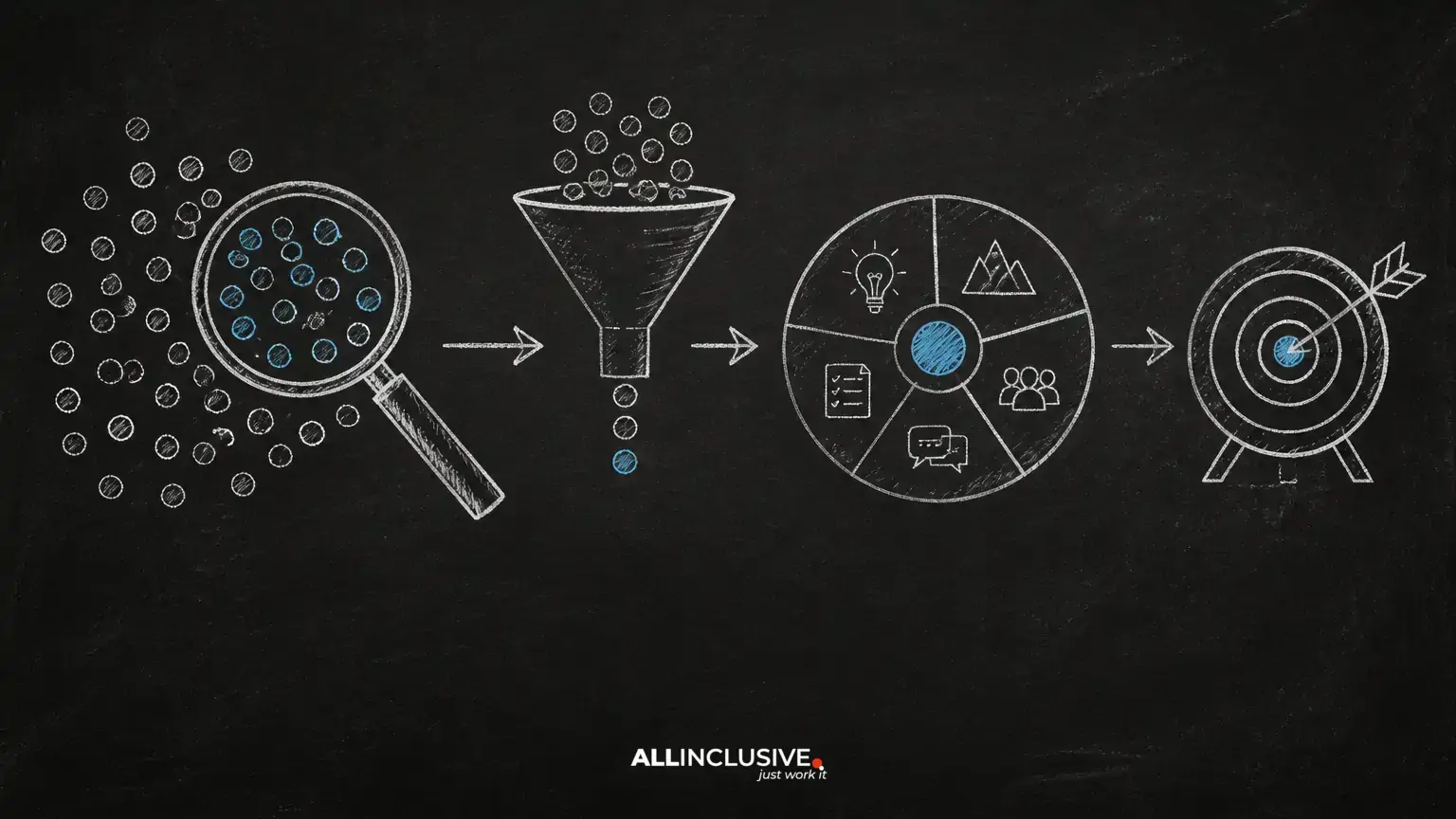
Keyword research is useful, but a spreadsheet of phrases is not a complete SEO strategy. When every keyword becomes a separate article brief, teams can produce repetitive pages, compete with their own content, and overlook the questions that matter most to potential customers.
A stronger approach uses keywords as evidence of demand and language, then organizes that evidence around topics, audiences, business goals, and search intent. The result is a content plan designed to solve problems rather than simply repeat phrases.
This process can support a broader SEO strategy while giving writers and editors clearer decisions about what to publish, update, combine, or leave alone.
Why keyword volume is not a content plan
Search volume can help estimate whether a subject is worth investigating, but it does not answer several important questions:
- What is the searcher actually trying to accomplish?
- Are several keywords describing the same need?
- What format would best answer the query?
- Does the topic support the organization’s products, services, or expertise?
- Does the website already have a page that should be improved instead?
A high-volume phrase may be broad, competitive, ambiguous, or poorly aligned with the audience. A lower-volume query may reveal a specific problem that is much closer to a purchase or conversion decision. Treat volume as one input among several, not as a publishing quota.
1. Start with existing performance
Before proposing new content, review what the site has already published. Existing pages can reveal where the website has authority, where visitors find value, and where effort is being spent without a clear return.
Questions to ask during a content review
- Which pages attract relevant organic visits?
- Which pages receive impressions but few clicks?
- Which pages rank for related queries but do not fully answer them?
- Are multiple URLs targeting the same subject?
- Which pages support meaningful business actions?
- Are older pages inaccurate, thin, or disconnected from current offerings?
Do not assume that every underperforming page needs more words. A page may need a clearer title, better alignment with intent, stronger internal links, updated information, improved structure, or consolidation with another URL. In some cases, removing or redirecting redundant content is more useful than publishing another article.
2. Build topic groups instead of isolated keyword lists
After collecting relevant queries, group them by the problem or task behind the search. The goal is not to force every phrase onto one page. The goal is to understand which searches can be answered together and which deserve distinct resources.
A practical grouping method
- Collect language. Gather queries from analytics tools, customer conversations, sales questions, site search, support tickets, competitor reviews, and existing page data.
- Normalize variations. Treat spelling differences, singular and plural forms, and close wording as potential variations rather than automatic publishing opportunities.
- Identify the underlying task. Ask whether the person is learning, comparing, evaluating, buying, troubleshooting, or looking for a specific provider.
- Cluster by answer. Put queries together when one thorough page could satisfy the same underlying need.
- Separate distinct needs. Create different groups when the audience, stage, desired action, or best content format changes.
For example, searches about choosing a service, comparing providers, understanding pricing, and fixing a problem may all mention the same industry term. They still represent different content opportunities because the useful answer and next step differ.
3. Classify search intent with nuance
Intent labels are helpful when they improve editorial decisions. They are less useful when treated as rigid categories. A query can have a primary intent and a secondary need, and the same wording may mean different things in different contexts.
Common intent patterns
- Learn: The searcher wants an explanation, definition, process, or checklist.
- Evaluate: The searcher is comparing approaches, tools, providers, or trade-offs.
- Act: The searcher wants to purchase, request help, book, register, or complete another transaction.
- Find: The searcher is looking for a particular website, brand, location, or resource.
- Solve: The searcher has a problem and needs diagnosis, instructions, or troubleshooting.
Intent should shape the page’s structure. A learning page might define terms, explain options, and provide examples. A comparison page should make evaluation criteria clear. A service page should explain fit, scope, process, and next steps without disguising sales copy as education.
4. Use search results as an intent check
Search results can provide useful clues about what a search engine currently considers relevant for a query. Review the result types, page formats, recurring subtopics, and apparent audience needs. This is not a request to copy competing pages. It is a way to test whether your proposed angle matches the task implied by the search.
What to examine
- Are results primarily guides, category pages, product pages, local listings, videos, or forums?
- Do top pages answer a narrow question or cover a broad subject?
- Are users looking for definitions, examples, prices, instructions, or recommendations?
- Do results suggest a local, commercial, technical, or beginner audience?
- Is the query ambiguous enough to require a page that addresses multiple interpretations?
Results change, and rankings are not permanent proof of quality. Use them as a current diagnostic during planning, then add independent expertise, original organization, and information that genuinely helps the intended reader.
5. Choose the right page type
A topic is not complete until the team knows what asset should address it. Possible formats include:
- Service or product page
- Step-by-step guide
- Glossary or foundational explainer
- Comparison or decision guide
- Case example or original analysis
- Template, calculator, checklist, or other practical tool
- Frequently asked question section
The format should follow the user’s task and the organization’s ability to provide a credible answer. A page that merely repeats general advice may not add value. A focused guide with clear assumptions, examples, limitations, and next steps can be more useful even when the target query appears less prominent.
6. Prioritize opportunities with a simple framework
Once topics are grouped and intent is documented, rank opportunities using consistent criteria. A lightweight scoring model can prevent search volume from dominating every decision.
| Criterion | Planning question |
|---|---|
| Audience value | Would this answer an important question for the people the organization wants to reach? |
| Business alignment | Does the topic connect naturally to a relevant service, product, or relationship? |
| Ability to help | Can the organization provide accurate, specific, and genuinely useful information? |
| Content gap | Is the current site missing, outdated, or confusing coverage? |
| Effort | What research, subject-matter review, design, or development is required? |
| Opportunity | Is there evidence that people seek this information through relevant channels? |
Scores do not need to be mathematically precise. Their purpose is to make trade-offs visible. A topic with moderate demand and strong audience value may deserve priority over a broad phrase with high demand but weak relevance.
7. Connect related pages with a clear architecture
Topic planning should lead to a coherent website structure. A central page can explain the main subject, while supporting pages address specific questions, use cases, or stages of the decision. Link these pages where the relationship is genuinely useful to readers.
Internal linking should help people move from general understanding to a more specific answer or action. Use descriptive anchor text, avoid forcing links into unrelated paragraphs, and review whether each linked page adds something distinct. This also helps editors identify content overlap and missing steps in the journey.
For broader technical and strategic considerations, readers can review the SEO services overview and the contact page when they need to discuss a specific website situation.
8. Measure usefulness, not just rankings
Rankings and organic clicks can be useful indicators, but they do not fully explain whether content is doing its job. Establish a measurement plan that reflects the page’s purpose.
- For educational content, monitor relevant visits, engagement signals, assisted actions, and feedback.
- For comparison content, assess progression to product or service pages and qualified inquiries.
- For service pages, track meaningful conversions and the quality of resulting contacts.
- For support content, look for reduced repeated questions or successful completion of the intended task where measurement is available.
- For all pages, review accuracy, freshness, internal-link health, and evidence of content overlap.
Performance data should guide iteration rather than trigger automatic expansion. If a page attracts an unexpected audience, determine whether to clarify its scope, serve that audience intentionally, or redirect attention to a more appropriate resource.
A practical workflow for editors and SEO teams
- Define the audience and business objective.
- Collect query language and first-party questions.
- Audit existing pages before commissioning new ones.
- Group queries by problem, audience, and desired outcome.
- Classify primary and secondary intent.
- Inspect result formats as a relevance check.
- Choose the best page type and content scope.
- Prioritize using value, alignment, evidence, and effort.
- Assign a distinctive URL and connect related pages.
- Publish, review performance, and update based on evidence.
Conclusion
Modern keyword research is most useful when it informs decisions rather than dictates article counts. By studying existing performance, grouping related searches, identifying intent, choosing appropriate formats, and prioritizing audience value, a team can build content that is more coherent and more useful.
The central question is not, “How many times should this phrase appear?” It is, “What does this person need, and what is the best resource our website can provide?” That shift creates a more durable foundation for SEO and a better experience for the people the content is meant to serve.