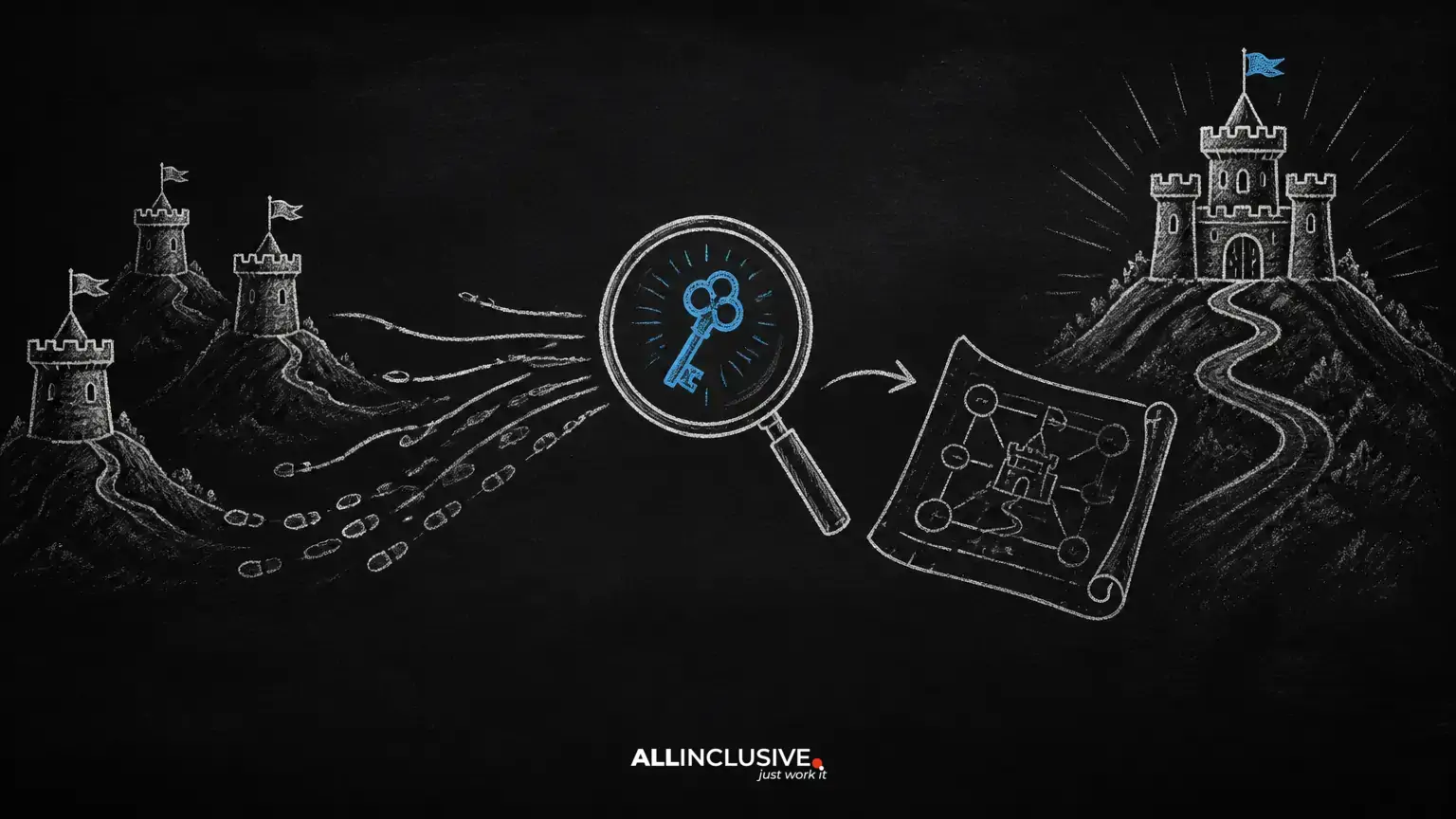
Advanced keyword research is less about finding more phrases and more about making better decisions. A useful process connects audience problems, search intent, competition, business value, and the pages you can realistically create or improve.
Keyword tools can accelerate discovery, but their estimates are not a substitute for judgment. Search behavior changes, databases are incomplete, and a keyword with attractive volume can still be a poor fit for your audience. The goal is a focused set of opportunities that supports a coherent content marketing strategy.
What makes keyword research advanced?
Basic research often starts with a seed phrase and produces related terms. Advanced research adds a decision layer. Before assigning a phrase to a page, evaluate:
- Relevance: Does the topic address a genuine problem for your audience?
- Intent: What is the searcher trying to accomplish?
- SERP shape: What formats and sources already satisfy the query?
- Business value: Could the topic support awareness, consideration, conversion, or retention?
- Site fit: Can your website provide a more useful answer than existing results?
- Content cost: Can you maintain the page as the subject changes?
This approach prevents a common failure: publishing many loosely related articles without a clear role for each one.
Start with audience problems, not tool suggestions
Begin with the questions, obstacles, comparisons, and decisions your audience encounters. Gather language from customer conversations, sales questions, support requests, product reviews, community discussions, and internal search data when available.
Record the wording without immediately turning every phrase into a target. Similar words can represent different needs. For example, a person searching for “content marketing examples” may want inspiration, while someone searching for “content marketing agency” may be evaluating a provider. The pages, calls to action, and proof required for those searches are different.
Build a seed-topic matrix
Organize ideas by audience stage and problem type rather than by keyword alone. A simple matrix might include:
- Definitions and foundational questions
- How-to tasks and implementation guides
- Comparisons and alternatives
- Templates, checklists, and examples
- Service or product evaluation
- Post-purchase troubleshooting and improvement
This matrix gives your research a purpose. Tools can then expand each topic without determining your entire editorial strategy.
Use keyword tools as discovery and validation aids
Keyword platforms can reveal related queries, questions, variations, estimated demand, and competitive signals. Treat these outputs as directional evidence rather than guaranteed outcomes. Metrics may differ between tools, and no estimate proves that a page will earn traffic or conversions.
For each promising topic, export or record a manageable set of terms. Include the main phrase, close variations, questions, modifiers, and concepts that repeatedly appear in relevant results. Avoid creating one page for every minor variation when those searches clearly share the same need.
Group by meaning, not spelling
Keyword clustering should answer a practical question: could one strong page satisfy most of these searches without becoming confusing or unfocused?
Group terms together when they share:
- The same underlying task or question
- A similar audience and knowledge level
- Comparable search intent
- Overlapping high-quality results
Separate them when the searcher expects a different format, outcome, audience, or stage of decision-making. A glossary definition, an implementation tutorial, and a service page may use related language but should normally have distinct jobs.
Classify intent from the results page
Intent labels are useful shorthand, but they should not replace inspection. A query may appear informational in a tool while the actual results emphasize product pages, local providers, videos, discussions, or comparisons.
Review the current results for a candidate topic and note:
- What the leading pages are trying to help users do
- Whether results are mostly articles, category pages, tools, videos, forums, or local listings
- How directly the results answer the query
- What questions or constraints remain unaddressed
- Whether the search appears broad or tied to a specific situation
Use these observations to choose the page type. A searcher asking “how to audit a website” may need a process and checklist; a searcher asking for “technical SEO services” may need scope, qualifications, expectations, and a contact path.
Find opportunities through SERP gaps
A gap is not simply a missing keyword. It is a meaningful way to help that current results handle poorly. Look for opportunities such as:
- Important prerequisites omitted from otherwise popular guides
- Advice that lacks practical examples or decision criteria
- Outdated workflows that need cautious verification
- Conflicting recommendations without a clear explanation of trade-offs
- Accessibility, implementation, or measurement details that are missing
- Audience-specific needs hidden inside general advice
Do not manufacture a gap by adding irrelevant sections. If a subject has no defensible improvement opportunity, it may not deserve a standalone page.
Match depth to the decision
More words are not automatically more useful. A short explanation can be appropriate for a simple definition, while a complex implementation guide may require examples, caveats, steps, and troubleshooting. Decide the required depth by asking what a reader must know to complete the task or make the decision confidently.
Prioritize by opportunity and effort
Search volume alone is a weak prioritization method. A practical scoring model can combine several qualitative factors:
- Audience importance: How closely does the topic relate to a defined audience need?
- Business alignment: Can the page support a legitimate organizational goal?
- Intent fit: Is the expected action compatible with what you offer?
- Evidence of demand: Do multiple signals support the topic?
- Competitive feasibility: Can the page offer a credible improvement?
- Production and maintenance effort: What expertise, review, design, or updates are required?
A lower-demand topic can be a better first choice when it closely matches an important problem and has a clear path to usefulness. Conversely, a popular term may be a poor investment when the intent is misaligned or the result page is dominated by formats you cannot reasonably compete with.
Turn research into a content architecture
Keyword research becomes more valuable when it defines relationships between pages. Choose a central pillar for a broad subject, then create supporting pages for distinct subtopics that deserve their own treatment. Link them where the connection helps readers move from general understanding to a specific task or decision.
For example, a content marketing pillar might connect to pages about audience research, editorial calendars, content measurement, distribution, and updating underperforming content. Each supporting page should have a distinct purpose rather than repeating the pillar in slightly different language.
Use descriptive anchor text that reflects the destination. Add links when they clarify a concept, provide a next step, or help the reader compare related guidance. Avoid forcing links into every paragraph or using the same anchor text mechanically.
Use first-party performance data carefully
When available, search performance data can reveal queries that already generate impressions, clicks, or visits. Look for pages with:
- Relevant impressions but weak engagement
- Queries that reveal an underserved subtopic
- Unexpected terms that fit the page’s actual subject
- Declining visibility that may indicate outdated or mismatched content
Diagnose before editing. Low click-through may reflect title and description problems, a result page dominated by features, or weak intent alignment. It may not mean the page needs more keyword repetition. A query that does not match the page’s purpose may be better handled with a new resource.
Optimize pages without forcing keywords
Once a target is selected, make the page easy to understand for people first. Place the primary concept where it accurately describes the page, including the title, introduction, relevant heading, and supporting copy when natural. Explain related concepts through clear language, examples, and useful terminology.
Also review:
- Whether the opening answers the reader’s central question
- Heading order and section progression
- Examples that show how advice works in context
- Internal links to relevant next steps
- Image descriptions that describe the image rather than repeat keywords
- Claims that need dates, qualification, or verification
Do not treat featured results, exact word counts, or keyword density as guarantees. Structured answers, lists, tables, and concise definitions can improve usability when the content genuinely calls for them, but formatting should serve the question.
Review and refresh the roadmap
Keyword research is a planning input, not a one-time publication event. Revisit priorities when your audience changes, offerings expand, competitors publish stronger resources, or search behavior shifts.
For each page, monitor meaningful outcomes such as qualified visits, engaged reading, assisted conversions, inquiries, downloads, or successful task completion. Interpret rankings and traffic alongside relevance and business results. A page can attract visits yet fail to help the right audience, while a focused resource with modest traffic may support valuable decisions.
A practical advanced keyword research workflow
- Define the audience, business objective, and problem area.
- Collect language from real questions and internal knowledge sources.
- Expand seed topics with keyword tools and related-result research.
- Classify intent by inspecting the actual results page.
- Cluster terms by meaning and decide whether each cluster needs a page.
- Identify a defensible usefulness gap.
- Score opportunities by relevance, value, feasibility, and effort.
- Assign each page a purpose, format, owner, and internal-link role.
- Publish a genuinely useful resource and connect it to the relevant pillar.
- Review performance and update the roadmap based on evidence.
Conclusion
Advanced keyword research is a disciplined way to choose useful subjects, not a race to collect phrases or promise rankings. Combine audience language, intent analysis, SERP observation, careful prioritization, and a connected content architecture. Then use performance data to improve decisions rather than to justify keyword stuffing. For organizations that need search strategy to support broader growth goals, explore SEO services as part of a coordinated plan.