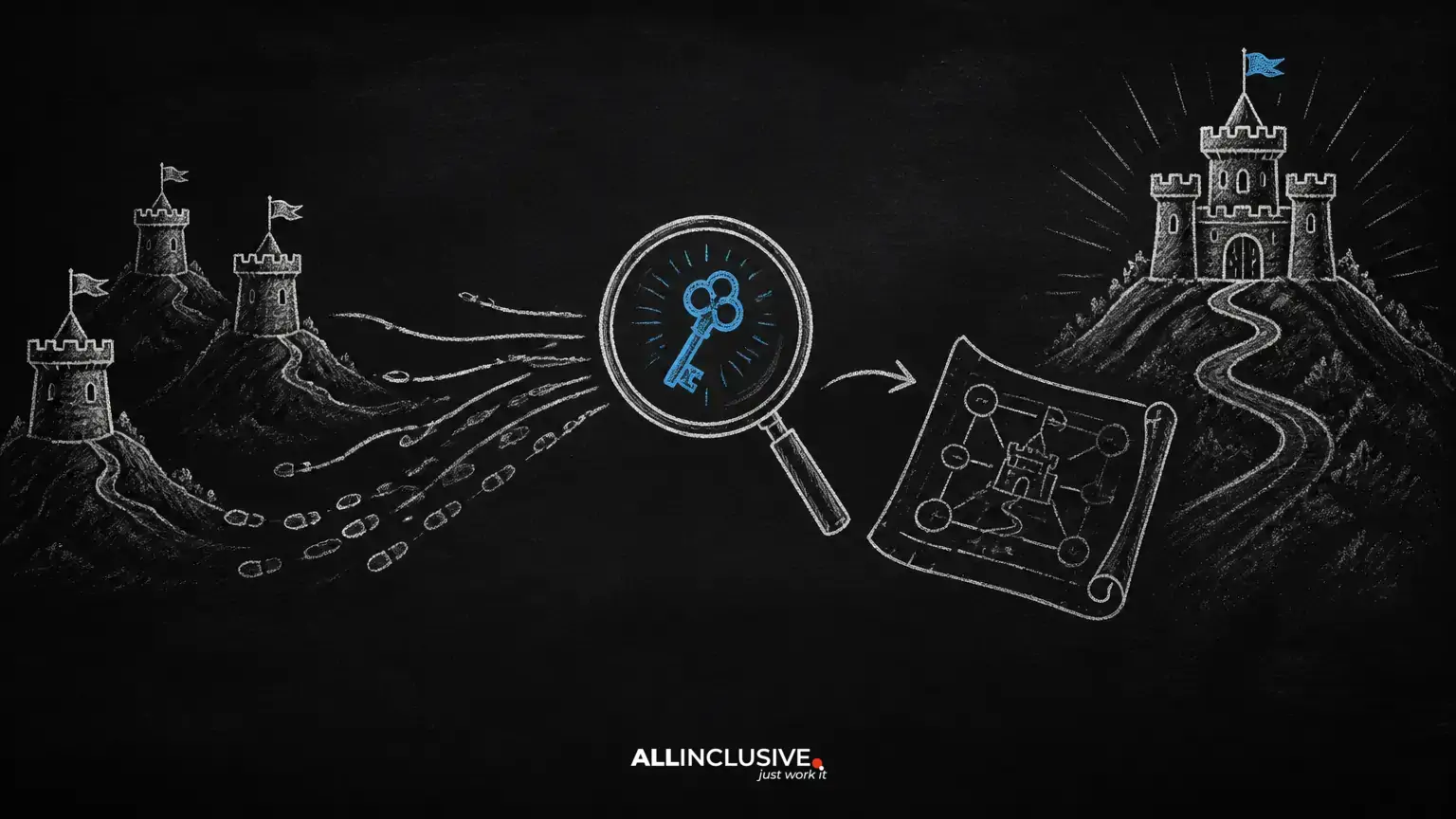
Keyword research is not simply a contest to find phrases with the highest search volume. It is a decision-making process: identify the questions and problems your audience brings to search, evaluate the results Google shows, and choose opportunities your organization can serve better than the alternatives.
A useful keyword list should help answer practical questions. Which audiences matter most? What does each searcher want to accomplish? Which topics deserve a new page, an update, or no page at all? How competitive is the opportunity? And how will success contribute to qualified visits, leads, sales, retention, or another defined business outcome?
This guide presents a durable process for answering those questions without treating any single tool, metric, or ranking as a guarantee.
What keyword research should accomplish
Keyword research gives an SEO program a shared language for connecting customer needs, content, and business priorities. It can inform site architecture, landing pages, editorial planning, product education, and measurement.
It should not be used to justify publishing pages for every variation of a phrase. Similar searches may represent the same need, while one broad phrase may contain several different intents. The goal is a focused map of valuable search themes and the pages that can satisfy them.
Start with business and audience context
Before opening a keyword tool, document the basics:
- The products, services, or solutions that generate meaningful value.
- The audiences you can serve, including their knowledge level and buying stage.
- The locations, industries, or use cases that matter.
- The problems your organization can solve credibly.
- The actions that indicate progress, such as a qualified inquiry, signup, purchase, or consultation request.
- Topics that are out of scope because they are irrelevant, unsupported, or unlikely to produce a useful outcome.
This context prevents a common failure mode: building a large list of phrases that attract attention but do not align with the organization’s offer or expertise.
Build a broad but relevant keyword set
Use several input types rather than relying on one source. Begin with seed topics drawn from customer language, sales conversations, support requests, product documentation, existing site navigation, and competitor offerings. Then expand those topics into questions, comparisons, problems, use cases, locations, and solution-oriented phrases.
Existing first-party evidence can be especially useful. Review internal search data, customer questions, sales objections, and pages that already receive impressions. These sources reveal language and needs that may not appear in a generic keyword database.
Keyword tools can help estimate demand and discover related terms, but their outputs are directional. Volumes may be rounded, modeled, or affected by geography, device, seasonality, and changes in search behavior. Treat metrics as inputs to judgment, not as promises of traffic or revenue.
Capture variations without creating unnecessary pages
Record meaningful variations, including synonyms, wording differences, questions, and modifiers such as “for beginners,” “near me,” “pricing,” or “comparison.” Do not automatically create one page per variation. First determine whether the variations share the same underlying need and search results.
When several phrases can be answered by one strong resource, group them into a single topic cluster. Separate pages may be appropriate when the audience, intent, product, location, or required answer is materially different.
Classify search intent
Intent is the reason behind a search. A practical classification can include:
- Informational: the searcher wants to understand a concept, solve a problem, or learn a process.
- Commercial investigation: the searcher is comparing options, providers, features, or approaches.
- Transactional: the searcher is ready to buy, subscribe, book, or take another direct action.
- navigational: the searcher is trying to reach a known brand, website, product, or resource.
Intent is not determined reliably by the wording alone. Search the phrase and study the results. Look at the types of pages ranking, the questions addressed, the apparent audience, and the features occupying the results page. A results page dominated by tutorials calls for a different resource than one dominated by service pages or product listings.
Also distinguish the user’s immediate question from the next useful step. An informational article may explain a problem and then point readers toward a relevant service or deeper guide. That transition should be helpful and natural, not a reason to distort the article’s purpose.
Evaluate the search results, not just the keyword metric
A keyword may look attractive in a spreadsheet but be a poor opportunity after inspection. For each priority topic, review:
- Whether the current results satisfy the apparent intent.
- Which content formats dominate, such as guides, category pages, local listings, videos, or tools.
- How specific and useful the leading pages are.
- Whether the results include strong brands, specialist publishers, forums, or user-generated content.
- How much of the page is occupied by ads, maps, images, videos, shopping results, or other features.
- Whether your organization has a credible reason to compete for the topic.
This is not a demand to imitate every ranking page. It is a way to understand the job a new page must perform. Look for gaps such as unclear explanations, outdated assumptions, weak examples, poor organization, or an audience that is not being served directly. A gap is meaningful only if you can fill it with accurate, original value.
Assess competition carefully
Competition is multidimensional. A tool’s competition label may describe advertising activity rather than organic ranking difficulty. Organic competition depends on the authority and relevance of the current results, the quality expected by searchers, the strength of the site and page, and the resources required to produce and promote a better answer.
A new or lightly established site may begin with narrower topics that match a specific audience or problem. An established site may have more capacity to pursue broader themes, but still benefits from validating intent before investing in content. Neither approach eliminates the need for quality, relevance, and patience.
Prioritize opportunities with a transparent framework
After grouping and classifying keywords, rank topics using consistent criteria. A simple worksheet can include:
| Criterion | Question |
|---|---|
| Business value | Could this topic support a meaningful business outcome? |
| Audience fit | Does the searcher resemble an audience the organization can serve? |
| Intent fit | Can the proposed page satisfy the need represented by the results? |
| Credibility | Can the organization provide trustworthy, firsthand, or expert-level value? |
| Effort | What research, production, technical work, and maintenance will be required? |
| Opportunity | Is there a realistic way to improve on the current experience? |
You can score these criteria using a scale that your team understands, but avoid pretending the result is mathematically precise. The purpose is to make assumptions visible, compare options consistently, and explain why one topic comes before another.
Prioritize a balanced portfolio. Include pages that support near-term business goals, foundational educational resources, topic clusters that strengthen the site, and updates to existing pages where improvement is more efficient than starting over.
Map keywords to pages and avoid cannibalization
Create a content map with one primary search need per page. Add related phrases only when they can be answered naturally within that resource. Record the intended page type, audience, funnel stage, internal links, conversion path, owner, and review date.
Before creating a new URL, check whether an existing page already targets the same intent. If it does, consider improving, consolidating, or repositioning that page. Publishing multiple near-identical pages can dilute maintenance effort and make the site less clear to users.
Keyword mapping is also useful for navigation and internal linking. An educational guide can link to a more detailed explanation, a relevant service, or a practical next step. Use descriptive anchor text that helps readers understand what they will find; do not force exact-match wording into every link.
Turn research into a content brief
A useful brief should translate research into an editorial assignment. Include:
- The primary topic and closely related questions.
- The intended reader and their likely stage of decision-making.
- The page’s purpose and recommended format.
- The key questions the page must answer.
- Evidence, examples, definitions, or process details needed for usefulness.
- Important caveats and claims that require verification.
- Relevant existing pages to link to and pages that should link back.
- A clear, non-misleading next step.
Do not turn the brief into a script that forces unnatural repetition. Write for comprehension first. Use the language your audience recognizes, explain specialized terms, and remove sections that do not advance the reader’s goal.
Measure outcomes and refine the research
Keyword research is not finished when a content calendar is published. After pages have had adequate time to be discovered and evaluated, review impressions, clicks, engagement signals, conversions, assisted outcomes, and the queries producing visibility. The appropriate measurement window depends on the site, topic, competition, and publishing pace, so avoid treating a fixed timeframe as universal.
Use the evidence to ask better questions. Is the page appearing for the intended topic? Are searchers finding it through related language? Does the page attract the right audience? Are visitors taking the next useful action? Does the result suggest a need for clearer content, stronger internal linking, a different format, or a different page altogether?
Update the research when the offer changes, audience needs shift, search results change, or new first-party questions emerge. Preserve a record of major assumptions so the team can distinguish a strategy change from a normal fluctuation.
Common keyword research mistakes
- Choosing volume over value: large demand does not guarantee relevance, qualified traffic, or conversions.
- Confusing paid and organic competition: advertising metrics should not be treated as a complete organic difficulty assessment.
- Skipping the results-page review: a spreadsheet cannot reveal format, intent, or the experience searchers expect.
- Creating pages for every variation: close variants often belong in one comprehensive resource.
- Ignoring existing content: improving a relevant page may be better than adding another URL.
- Making unsupported promises: keyword research can improve decisions, but it cannot guarantee rankings, traffic, or revenue.
A practical standard for better keyword decisions
Strong keyword research is audience research, business analysis, and content planning in one process. Start with the problems you can solve, expand the language people use, inspect the results, group related needs, prioritize transparently, and connect every chosen topic to a page and a measurable purpose.
For a broader view of how research fits into a sustainable search program, explore Allinclusive SEO services. You can also review the contact page when you are ready to discuss your organization’s search objectives and constraints.
The best keyword list is not the longest one. It is the one that helps your team create clearer resources for the right audience and make better investments over time.