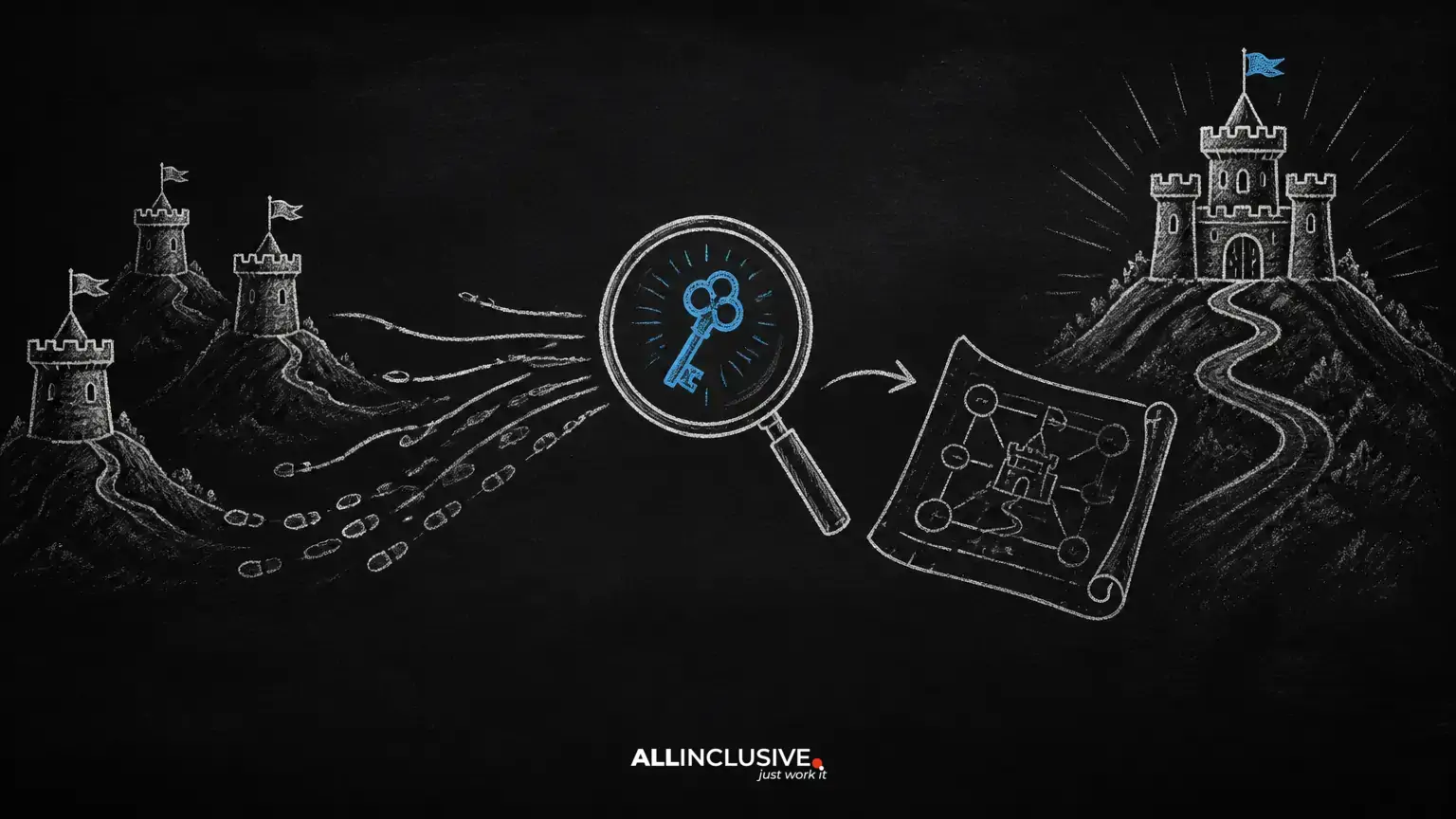
Keyword difficulty is a search engine optimization (SEO) metric intended to estimate how challenging it may be to rank for a particular search query. Most keyword research platforms express it as a score or percentage, but the number is only a comparative signal. It does not guarantee a ranking position, a timeline, or a specific amount of traffic.
Used carefully, keyword difficulty helps you decide which topics to pursue now, which require stronger supporting content, and which belong in a longer-term plan. Used alone, it can lead to poor decisions—such as ignoring valuable topics because they look competitive or choosing low-difficulty phrases that have little relevance to your audience.
What does keyword difficulty measure?
Keyword difficulty generally reflects the strength of pages that already appear in search results for a query. Depending on the platform, the calculation may consider signals such as competing pages’ link profiles, domain-level authority estimates, or other characteristics of the current search results.
Because every provider calculates the metric differently, a score from one tool should not be treated as interchangeable with a score from another. The useful question is not whether a keyword has an objectively “true” difficulty value. The useful question is whether the score helps you compare opportunities within the same research process.
Difficulty also applies to a specific search result environment. Competition can vary by country, language, device, location, and the way a query is interpreted. A keyword that appears accessible in one market may be substantially more competitive in another.
Why keyword difficulty matters in content planning
A content idea can be relevant and popular yet still be a poor immediate target if the current results are dominated by well-established pages that satisfy the search intent exceptionally well. Difficulty gives your team a way to account for the effort required before committing resources.
It can help you:
- Prioritize realistic topics for a new or developing website.
- Estimate whether a page may need supporting content, promotion, or links.
- Balance near-term opportunities with important long-term topics.
- Set more honest expectations about the time required to earn visibility.
- Identify topics where a narrower, more specific query may be a better starting point.
Difficulty should influence prioritization, not replace editorial judgment. A highly competitive keyword may still be strategically important if it describes a core product, service, or subject your organization must be associated with.
What makes a keyword difficult?
Strong pages already rank
Review the actual search results rather than relying only on a score. Look at whether the ranking pages are comprehensive, current, well organized, and clearly written for the query. Consider whether they come from sites with established expertise in the topic or from pages that address the query only superficially.
Search results can also include different formats, such as guides, category pages, videos, local listings, product pages, or definitions. If the results consistently favor a format different from the one you plan to publish, the challenge may be intent alignment rather than authority alone.
Competitors have earned relevant links and recognition
Links from other websites can help a page become discoverable and can serve as one signal of its prominence. However, a large link count does not automatically mean that a page is useful or unbeatable. Relevance, quality, context, and the overall strength of the competing page matter.
Do not assume that publishing a page or acquiring links will produce a predictable ranking outcome. Treat link acquisition as one part of a broader process that includes creating something worth referencing and promoting it responsibly.
The topic is broad
Broad terms often combine several possible intents. For example, a general phrase may attract people looking for an explanation, a vendor, a comparison, or a specific task. A page attempting to satisfy every interpretation can become unfocused.
A narrower query often provides a clearer editorial assignment. It may have fewer searches, but the visitors can be more relevant because the query reveals a specific problem, audience, location, or stage of decision-making.
Your website has limited topical evidence
Search engines evaluate pages in context. A site with little relevant content may find it harder to demonstrate depth on a broad subject than a site that has consistently covered the topic from multiple useful angles. This does not create a permanent barrier, but it can affect the order in which you build your content library.
How to interpret a keyword difficulty score
Difficulty scores are best used for comparison within one tool and one market. Avoid treating a threshold such as “easy” or “hard” as a universal rule. A score that is challenging for a newer website may be manageable for a site with strong topical coverage and an established audience.
Use the score as an initial filter, then validate the opportunity by asking:
- Is the topic directly relevant to the audience and the organization?
- What type of page does the searcher appear to want?
- Can we create a meaningfully more useful result than the current options?
- Do we have first-hand knowledge, evidence, or expertise to add?
- Would success support a business, audience, or customer-service objective?
- What internal links and supporting pages would make the resource more useful?
These questions turn a numerical estimate into a practical publishing decision.
Keyword difficulty and search intent
Search intent describes the underlying goal behind a query. A searcher may want to learn, compare alternatives, find a specific website, or complete a transaction. A page can be well written and still struggle if it does not match that goal.
Before drafting, inspect the current results and identify patterns:
- Informational intent: explain a concept, process, or problem.
- Commercial investigation: help the reader compare options or evaluate a solution.
- Transactional intent: support a clear action, such as requesting a quote or making a purchase.
- Navigational intent: help someone reach a particular brand, resource, or page.
Intent can change over time, so validate it when you begin a new project and when you substantially update an existing page. The goal is not to copy the current results. It is to understand the job the search result is expected to perform.
How to choose between a difficult and an easier keyword
A balanced content plan usually includes both attainable opportunities and important competitive subjects. Easier, specific queries can help you answer real questions and develop topical coverage. More competitive terms can serve as long-term pillar topics when they are central to your audience and business.
Consider using a simple prioritization framework:
| Question | Why it matters |
|---|---|
| Relevance | Traffic is less valuable when the topic does not fit the audience or offering. |
| Intent fit | The correct page type improves usefulness and competitiveness. |
| Business value | Some topics support important decisions even when they are difficult. |
| Achievability | Lower-competition topics may provide more realistic near-term opportunities. |
| Content advantage | Original expertise, examples, tools, or evidence can strengthen the page. |
| Required support | Broad topics may need internal links, updates, promotion, or related pages. |
This framework prevents search volume or difficulty from becoming the only deciding factors.
Do long-tail keywords always have low difficulty?
Long-tail keywords are typically more specific phrases, often describing a detailed question, use case, audience, or location. They can be easier to target because fewer pages address the exact combination of words. That is not guaranteed, however. A specific query can still be valuable and competitive, especially when it signals strong commercial intent.
Do not select a long-tail phrase merely because it appears to have a low score. Confirm that it represents a real need and that your page can answer it completely. You may also find that several closely related phrases belong on one well-structured page rather than on separate pages with overlapping content.
How to use keyword difficulty in a content workflow
1. Start with audience problems
List the questions, tasks, concerns, and decisions your audience faces. Then group similar phrases into topics instead of building a separate article for every variation.
2. Check the search results
Examine the pages currently visible for the main query. Note their format, scope, freshness, strengths, and weaknesses. Look for unanswered questions or audiences that are poorly served, but do not assume a weakness is enough to produce a ranking change.
3. Compare difficulty within one tool
Use a consistent source to compare related queries. Record the market and language settings so that later comparisons remain meaningful. Treat the score as an estimate and document the assumptions behind your decision.
4. Build a page that earns its place
Define a clear purpose, cover the essential questions, use descriptive headings, and make the information easy to scan. Add relevant examples, limitations, definitions, or decision guidance where they improve the reader’s outcome.
5. Connect the page to the wider site
Internal linking helps readers discover related resources and gives search engines additional context. Place links where they genuinely help the reader, using descriptive anchor text. For broader planning, review the Allinclusive content marketing resource and consider how the page fits into a larger topic cluster.
6. Measure and revise responsibly
After publication, monitor impressions, clicks, engagement signals available to you, conversions, and qualitative feedback. A page may need a clearer answer, better structure, stronger internal links, or a different target—not simply more keywords.
Common mistakes to avoid
- Treating a score as a promise: difficulty is an estimate, not a ranking forecast.
- Using scores from different tools as if they were identical: methodologies and scales vary.
- Chasing low difficulty without relevance: easy visibility is not useful if it attracts the wrong audience.
- Ignoring the current results: the page format and intent often matter as much as competition.
- Creating one page for every keyword variation: this can cause overlap and dilute the site’s usefulness.
- Assuming authority fixes weak content: a strong domain does not remove the need for accuracy and intent alignment.
- Promising a fixed timeline: ranking changes depend on many external and site-specific variables.
Conclusion
Keyword difficulty is most useful as a planning aid. It helps you compare opportunities, estimate the support a topic may require, and sequence content development. It should always be considered alongside relevance, search intent, business value, the quality of the current results, and your site’s existing topical coverage.
For a broader technical and strategic foundation, explore Allinclusive SEO services. The best keyword strategy is not the one with the lowest scores; it is the one that consistently produces useful pages for the right audience and supports meaningful organizational goals.