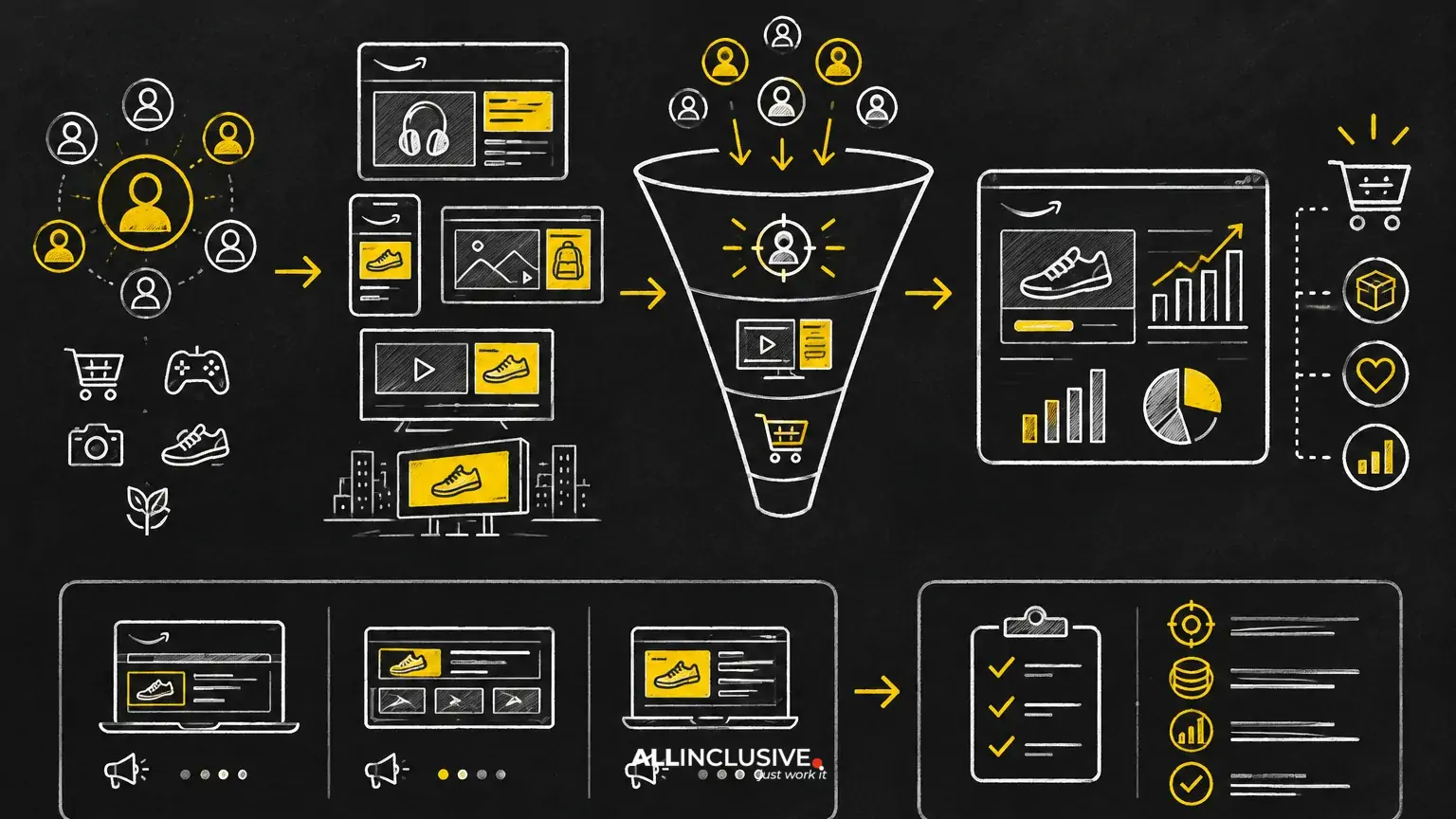
Amazon Sponsored Brands are ads designed to help shoppers discover a brand and its product range, rather than promoting only one product detail page. They can appear in prominent shopping placements and may direct traffic to a brand destination, a product collection or an individual product detail page, depending on the format and account setup.
The most effective way to use them is not as a replacement for Sponsored Products, but as a complementary layer. Sponsored Products are often central to product-level demand capture; Sponsored Brands can support brand visibility, category navigation, product discovery and consideration across a broader set of offerings. Results depend on eligibility, inventory, retail readiness, targeting, creative quality and the placement options available in the relevant marketplace.
This guide explains the main amazon sponsored brands formats, how to approach creative, when each use case makes sense and how to evaluate performance without confusing brand-building objectives with direct-response efficiency.
What are Amazon Sponsored Brands?
Amazon Sponsored Brands are pay-per-click advertising campaigns associated with a brand and its products. Advertisers typically choose a combination of targeting, creative assets, featured products and a destination. The campaign then competes for eligible placements based on the account’s settings, bid strategy and auction conditions.
Unlike a single-product ad, a Sponsored Brands campaign can present a broader brand proposition. Depending on the available format, that proposition may include a brand logo, headline, product imagery, a selection of products or a link to a branded shopping destination. The precise creative and placement experience can vary by marketplace, account eligibility and Amazon’s current product capabilities, so campaign planning should be based on the options visible in the advertising console.
Sponsored Brands formats
Collection-style formats
Collection-style ads feature several products together, allowing the advertiser to frame a group around a category, use case or product line. They are useful when shoppers may need to compare options or when the brand has a coherent range rather than one obvious hero product.
For example, a personal-care brand might promote a cleanser, moisturizer and sunscreen as a daily routine. A homeware brand could group storage products by room or size. The strongest collections have a clear reason for the products to appear together; assembling unrelated products can make the ad harder to understand and weaken the landing-page experience.
Video formats
Sponsored Brands video can communicate product use, design, materials or a key benefit quickly. Video is particularly useful when a product’s value is difficult to convey through a static image or when demonstration can reduce uncertainty before the shopper reaches the detail page.
Creative should work without relying on sound or a long explanation. The opening moments need to establish the product and context, while the rest of the asset should make the use case easy to understand on a small screen. Product claims should remain consistent with the detail page and comply with the applicable advertising and marketplace requirements.
Brand-led creative
Some Sponsored Brands experiences put greater emphasis on the brand identity, including logo and headline elements. This approach can help established brands reinforce recognition and guide shoppers toward a wider catalog. It is less effective when the headline is vague or the brand has not yet earned meaningful consideration in the category.
Brand-led creative should still answer a shopper question: What does this brand offer, who is it for, or why should the shopper explore it? A logo alone is rarely a sufficient value proposition.
Store and collection destinations
A Sponsored Brands ad may send shoppers to a branded destination or a product-focused page. A Store can be useful when the brand needs to organize multiple categories, explain its range or present merchandising paths. A focused collection or detail page may be more appropriate when the ad addresses a narrow search intent.
The destination should match the ad’s promise. A campaign promoting a specific product family should not send shoppers to a crowded homepage where the advertised products are difficult to find. Before launch, review the destination on mobile and confirm that featured products are available, competitively presented and aligned with the targeting.
Creative principles that improve clarity
Lead with the shopping problem
Effective creative starts with the need behind the query. A headline can emphasize a product category, use case, material, format or differentiating feature, provided the message is accurate and understandable. Avoid using brand language that means something internally but gives shoppers no reason to click.
Keep products commercially ready
Sponsored Brands cannot compensate for weak retail execution. Featured products should have clear titles, strong imagery, useful detail-page content, appropriate pricing and available inventory. Reviews, variations and fulfillment considerations may also influence how well traffic converts, even though they are not controlled by the ad creative itself.
Build a coherent product set
Select products with a logical relationship. Consider organizing by:
- Customer need or use case
- Product category or subcategory
- Price or feature tier
- Complementary products
- Seasonal or promotional relevance
Do not judge a product set only by individual sales volume. A lower-volume product may play an important role in helping shoppers understand the range or move toward a higher-value purchase. However, every included product should have a credible role in the destination experience.
Make the first impression understandable
Shoppers scan quickly. The combination of headline, imagery and featured products should make the ad legible without requiring interpretation. Use a direct message, avoid unnecessary jargon and ensure that the visual hierarchy remains clear on smaller screens.
Targeting options and campaign structure
Sponsored Brands can support both keyword and product-oriented targeting, subject to the options available in the marketplace and account. Keyword targeting can capture category, feature and brand-intent searches. Product targeting can place a brand in relation to selected products or categories and may support conquesting, complementary positioning or defensive coverage.
Structure campaigns so that targeting and objectives can be evaluated separately. A practical framework may include:
- Brand defense: protect searches that include the brand name or branded product terms.
- Category discovery: reach shoppers searching for relevant generic terms.
- Competitor or alternative targeting: test visibility against related products where the proposition is genuinely relevant.
- Product-line campaigns: organize collections around a category, use case or range.
- Video tests: isolate video creative so engagement and conversion can be evaluated appropriately.
Campaign segmentation should be useful, not excessive. Split campaigns when differences in targeting, budget, creative, destination or measurement would change a decision. Avoid creating so many small campaigns that budgets and data become difficult to interpret.
When to use Amazon Sponsored Brands
Introducing or expanding a product range
Sponsored Brands can help connect a shopper’s category search with a broader product selection. This is valuable when the brand has several relevant products and wants to establish a recognizable presence beyond a single listing.
Supporting branded search demand
Brand-defense campaigns can help control the path shoppers take after searching for the brand. The goal is not always incremental demand; it may be to guide existing interest toward the most commercially important products, collections or promotions.
Building consideration for higher-consideration products
When shoppers need more information before choosing, a Store, collection or video destination can provide additional context. Sponsored Brands may be appropriate when the campaign needs to explain a system, product family or differentiated use case rather than send every click to one detail page.
Merchandising complementary products
A collection can make cross-selling more deliberate. For example, a brand may group a primary product with compatible accessories or replenishment items. The relationship should be obvious, and the destination should make it easy for shoppers to continue exploring.
Supporting launches and seasonal moments
Sponsored Brands can provide a branded entry point during a launch or seasonal period. Plan early enough to validate creative, inventory and destination readiness. A campaign should not send increased traffic to a product that cannot support demand or a page that still contains incomplete information.
Measurement: match the metric to the objective
Direct-response metrics such as attributed sales, orders, return on ad spend and advertising cost of sales remain important, but they should be interpreted in context. A brand-defense campaign may appear efficient because it captures shoppers who already intended to buy. A category-discovery campaign may require a different efficiency expectation because it is reaching shoppers earlier in the decision process.
Review performance across several dimensions:
- Impressions and click-through rate for visibility and message relevance
- Attributed sales and orders for direct commercial outcomes
- New-to-brand indicators, where available and appropriate to the account
- Conversion rate by targeting type, destination and featured product
- Spend distribution across branded, generic and product-targeted demand
- Performance by device, placement and marketplace when reporting supports the comparison
Do not treat one metric as a universal success threshold. Compare campaigns with similar objectives, targeting and retail conditions. Also account for assisted discovery and the possibility that shoppers interact with multiple ad types before purchasing.
For a broader view of efficiency metrics and tradeoffs, see our guide to ACOS versus ROAS in Amazon Ads.
Optimization workflow
- Confirm retail readiness. Check availability, detail-page quality, pricing, variations and destination accuracy.
- Define the campaign role. Decide whether the campaign is intended for defense, discovery, range merchandising, consideration or a launch.
- Align creative and destination. Ensure the headline, products and landing experience communicate the same proposition.
- Separate meaningful tests. Test one major variable at a time where possible, such as video versus collection creative or a broad category message versus a use-case message.
- Review search and product insights. Look for irrelevant queries, promising themes, weak destinations and products that attract clicks but fail to convert.
- Adjust targeting and budget deliberately. Move investment toward campaigns that meet their defined objective, while preserving enough budget for controlled learning.
- Document changes. Record creative, bid, targeting and destination changes so performance shifts can be interpreted rather than guessed at.
Sponsored Brands should also be evaluated alongside the rest of the account. Sponsored Products, Sponsored Brands and Amazon DSP can reach different stages of the customer journey and should not be optimized in isolation. Our Amazon Sponsored Products guide covers product-level campaign structure and optimization, while the Amazon DSP guide explains how audience and inventory strategies differ from sponsored ads.
Amazon Sponsored Brands: Mistakes to Watch For
- Using one generic headline across every campaign: different queries and product groups often need different messages.
- Sending all traffic to the brand homepage: a focused destination usually creates a clearer path for a specific promise.
- Featuring unavailable or weak products: ad exposure cannot repair an unready product page.
- Evaluating only last-click efficiency: this can undervalue discovery campaigns and overvalue existing brand demand.
- Over-segmenting the account: excessive campaign fragmentation makes learning and budget control harder.
- Ignoring search intent: a brand message should still be relevant to what the shopper is trying to find.
How Sponsored Brands fit into an Amazon advertising strategy
Sponsored Brands are most useful when they have a defined role in the wider plan. Use them to connect brand identity with relevant shopping intent, organize product discovery and support consideration where a single product ad is too narrow. Pair them with product-level campaigns for demand capture and consider DSP only when the audience, inventory and measurement requirements justify a broader media layer.
For a complete view of campaign roles, targeting and retail signals, read our Amazon advertising strategy guide. You can also explore the broader Amazon advertising pillar and the full paid media resource hub.
The central decision is simple: use Sponsored Brands when the campaign needs to present a brand or product range, not merely win a click for one item. Strong results come from matching the format, creative, targeting and destination to a specific commercial objective—and then judging performance against that objective.