
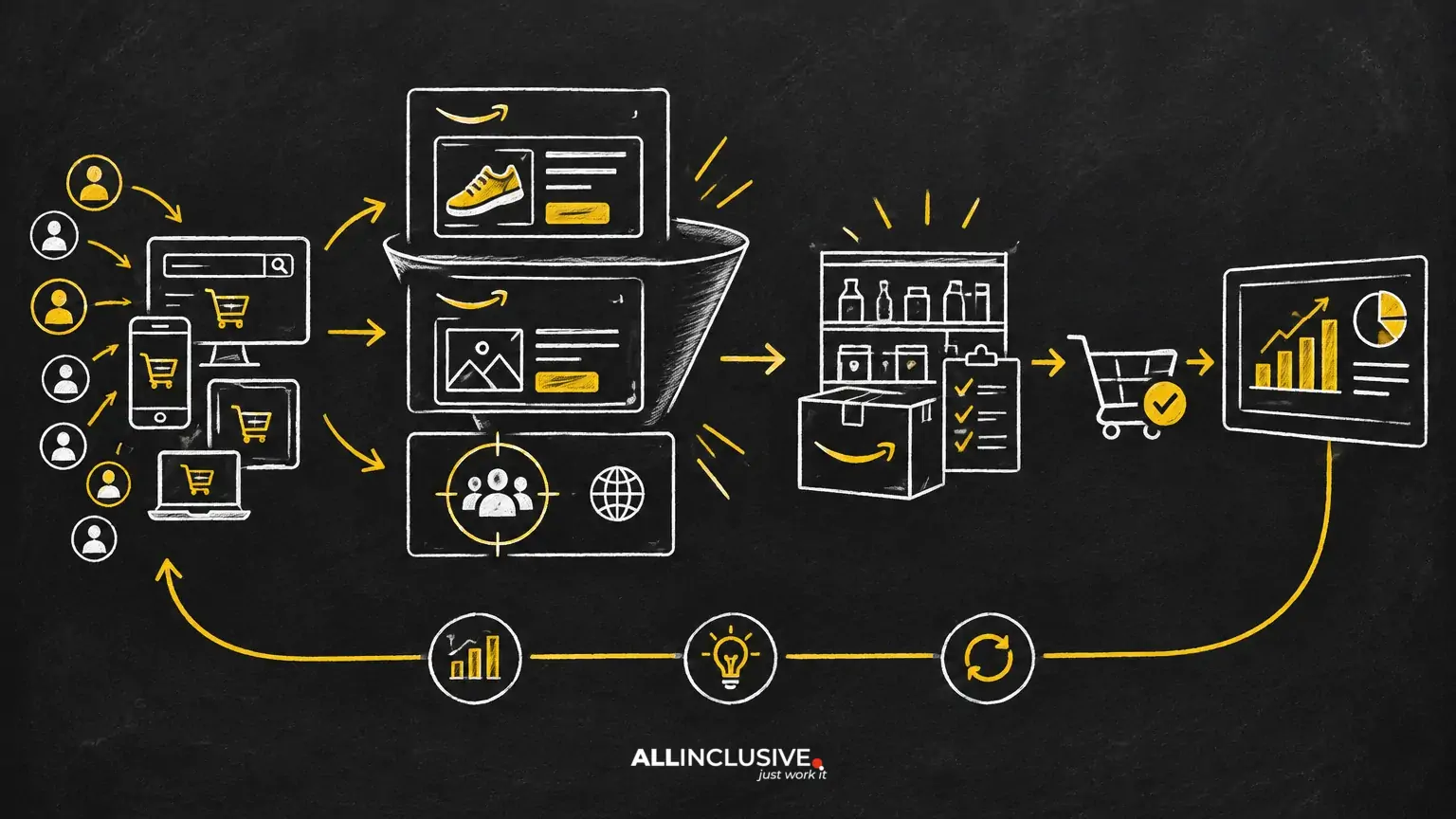
An effective amazon advertising strategy is more than a collection of Sponsored Products campaigns. It connects customer intent, retail readiness, media investment, audience development and measurement across the Amazon ecosystem.
The right approach depends on what you are trying to accomplish. Sponsored ads can capture active shopping demand. Amazon DSP may support audience development and consideration across eligible inventory. Retail signals—such as detail-page quality, availability, pricing and conversion behavior—help determine whether media can convert efficiently. Treating these elements as one system produces better decisions than optimizing bids in isolation.
This guide explains how to build that system, when to use each advertising layer and how to create a measurement framework that supports commercial decisions.
Start with the commercial objective
Before selecting campaign types, define the business constraint. A brand trying to defend branded demand needs a different structure from one launching a new product, expanding into a category or improving profitability on an established catalog.
Common objectives include:
- Demand capture: reach shoppers already searching for relevant products or categories.
- Consideration: introduce a product to audiences who may not yet be searching for the brand.
- Retail growth: increase sales while maintaining availability, detail-page quality and acceptable contribution margins.
- Portfolio support: use advertising to move shoppers between complementary, premium or replacement products.
- Efficiency: control wasted spend, improve query quality and allocate budget toward commercially valuable demand.
These objectives can coexist, but they should not be evaluated with one blended success metric. A campaign designed to protect branded demand may be judged on visibility and sales defense, while a prospecting program may require a longer consideration window and different evidence of progress.
Build the strategy around three advertising layers
1. Sponsored ads for active demand
Sponsored ads are generally the first layer to address because they can connect advertising with shoppers who are already browsing or searching. They are useful for capturing relevant demand, defending branded queries, testing product-category relationships and identifying the search terms that convert.
Structure should reflect intent rather than simply mirroring the catalog. Separate brand, non-brand, competitor and category opportunities where the reporting and budget decisions differ. Product launches may require dedicated campaigns so that early data is not obscured by mature products. High-margin or strategically important products may also deserve distinct controls.
For a deeper treatment of architecture, targeting and bids, see our Amazon PPC strategy guide. The central principle is to make each campaign answer a clear business question: Which demand are we pursuing, how much are we willing to pay for it, and what action will follow from the result?
2. DSP for audience development and broader reach
Amazon DSP can play a different role from search-led sponsored advertising. Depending on account access, inventory and objectives, it may be used to reach audiences across the purchase journey, support product launches, re-engage shoppers or extend a brand’s presence beyond active search moments.
DSP should not be added simply because a brand wants more reach. It is more appropriate when the business has a clear audience hypothesis, sufficient creative and landing-page readiness, a meaningful consideration challenge or a need to coordinate upper- and lower-funnel activity.
Useful questions include:
- Are we trying to reach new audiences, re-engage shoppers or support existing demand?
- What evidence would distinguish incremental reach from duplicated exposure?
- Do we have enough product availability and creative variation to support the program?
- Can the team evaluate performance beyond immediate last-touch sales?
For a focused explanation of audience, inventory and fit, read our Amazon DSP guide.
3. Retail signals as the conversion layer
Media cannot compensate indefinitely for retail friction. If a product is unavailable, poorly presented, uncompetitive or difficult to understand, additional impressions may create cost without proportional commercial value.
Before scaling spend, review the conditions that influence conversion:
- Product availability and fulfillment consistency
- Detail-page content, imagery and mobile usability
- Review quality and customer feedback themes
- Price position and promotional context
- Variation structure and product selection
- Brand-store or destination experience where relevant
- Inventory constraints that could make incremental demand unprofitable
These are not merely merchandising considerations. They affect how media should be interpreted. A fall in advertising efficiency may reflect weaker retail readiness rather than a bidding problem.
Use a funnel, but do not force every campaign into one
Funnel language is useful when it clarifies roles. It becomes unhelpful when every impression is labeled upper funnel and every sale is treated as lower funnel.
A practical structure is:
- Capture: sponsored campaigns focused on relevant, active shopping demand.
- Develop: DSP or other audience programs designed to create consideration or re-engage qualified shoppers.
- Convert: product detail pages, offers, availability and checkout experience that turn interest into sales.
- Learn: search-term, product, audience and retail signals that improve the next allocation decision.
The layers should inform one another. Search-term data may reveal language for creative. Product engagement may suggest retargeting audiences. Retail performance may identify products that should be excluded from expansion until availability or content improves.
Design campaign architecture for decisions
Campaign structure is a measurement and governance tool. It should make budget allocation, query control and product-level analysis possible without creating unnecessary complexity.
At minimum, define separations where the commercial logic differs:
- Branded versus non-branded demand
- Discovery versus proven targets
- Product launches versus mature products
- Strategic products versus long-tail products
- Different countries, marketplaces or operational owners
- Different profitability or inventory constraints
Use naming conventions that identify marketplace, objective, product group, targeting type and time or test status. Keep a change log for major bid, budget, targeting and creative decisions. Without this discipline, performance reviews often become explanations of what happened rather than decisions about what to do next.
Set budget rules before performance pressure arrives
A budget should reflect the role of a campaign, not only its recent attributed sales. A branded defense campaign, a category discovery campaign and a DSP prospecting program may all have different acceptable efficiency thresholds.
Define:
- The business objective and intended customer stage
- The primary metric and supporting indicators
- The acceptable efficiency range or contribution requirement
- Conditions for increasing, holding or reducing budget
- Inventory and margin restrictions
- The review window needed before making a decision
Avoid reacting to a single day or isolated search term unless there is a clear operational problem. Consider seasonality, campaign maturity, stock position, promotional periods and meaningful changes to targeting or creative.
Measure with a hierarchy of evidence
Measurement should connect platform reporting to business outcomes while acknowledging attribution limits. Use a hierarchy rather than a single dashboard number.
Level one: delivery and control
Review spend, impressions, reach where available, clicks, targeting coverage, frequency where relevant and budget utilization. These metrics show whether the program is delivering as intended, but they do not prove commercial value.
Level two: engagement and retail response
Assess click quality, detail-page visits, branded search behavior, product engagement, add-to-cart signals where available and conversion behavior. These indicators help diagnose whether the issue is audience quality, message relevance or retail readiness.
Level three: commercial performance
Evaluate attributed sales, new-to-brand behavior where available, product-level outcomes, cost of advertising and contribution economics. Keep the reporting definitions consistent across periods, and document any changes in attribution windows or campaign scope.
Level four: incrementality and business impact
When practical, use controlled tests, geographic comparisons or other defensible methods to examine whether media created additional demand rather than simply receiving credit for demand that would have occurred anyway. The method should match the decision and be interpreted cautiously.
Coordinate search, DSP and retail operations
Amazon advertising often spans teams. Media specialists may control campaigns, while merchandising, creative, inventory and finance teams control the factors that determine whether advertising can scale.
Create a recurring operating rhythm with a shared view of:
- Products that should receive increased or reduced support
- Search terms and audience groups showing emerging opportunity
- Products affected by availability, pricing or content issues
- Creative tests and their intended learning objectives
- Budget changes and the commercial rationale behind them
- Upcoming launches, promotions and seasonal constraints
This turns optimization from a sequence of isolated platform edits into a coordinated commercial process.
Common strategy failures
Optimizing only for attributed sales
Last-touch or platform-attributed sales can be useful for management, but they may undervalue demand development and overstate the role of lower-funnel touchpoints. Pair attributed outcomes with retail, audience and incrementality evidence where available.
Scaling before fixing retail readiness
More traffic does not solve weak content, poor availability or an uncompetitive offer. Diagnose the retail constraint before increasing media pressure.
Combining unlike objectives
When branded defense, non-brand discovery and prospecting are placed into one budget and one efficiency target, the resulting optimization can favor whichever activity converts most easily—not necessarily the activity that supports growth.
Changing too many variables at once
Large simultaneous changes to bids, budgets, targeting and creative make learning difficult. Prioritize the highest-value hypothesis, define the expected signal and record the result.
A practical implementation sequence
- Audit the commercial context: review catalog priorities, margins, availability, content, pricing and marketplace coverage.
- Map demand: separate branded, non-branded, category, competitor and product-targeting opportunities.
- Assign channel roles: define what sponsored ads, DSP and retail operations are each expected to accomplish.
- Build decision-ready campaigns: use logical segmentation, naming conventions, budgets and exclusions.
- Launch measurement: establish reporting definitions, review cadence and test plans before scaling.
- Optimize by constraint: determine whether the limiting factor is demand, targeting, creative, conversion, inventory or economics.
- Scale selectively: increase investment where evidence supports additional demand and the retail system can fulfill it.
For a broader view of channel planning and measurement, explore our paid media resources. For brand-level planning and service considerations, see our Amazon advertising overview.
Amazon Advertising Strategy: Strategic Perspective
The strongest Amazon advertising strategy is not the one with the most campaigns or the most aggressive bids. It is the one that assigns each advertising layer a clear role, protects retail fundamentals and turns platform signals into disciplined commercial decisions.
Sponsored ads can capture existing intent. DSP can support audience development when its role is clear. Retail signals determine whether that investment can convert and scale. When these elements are planned together, performance management becomes less about chasing isolated metrics and more about building a repeatable growth system.


