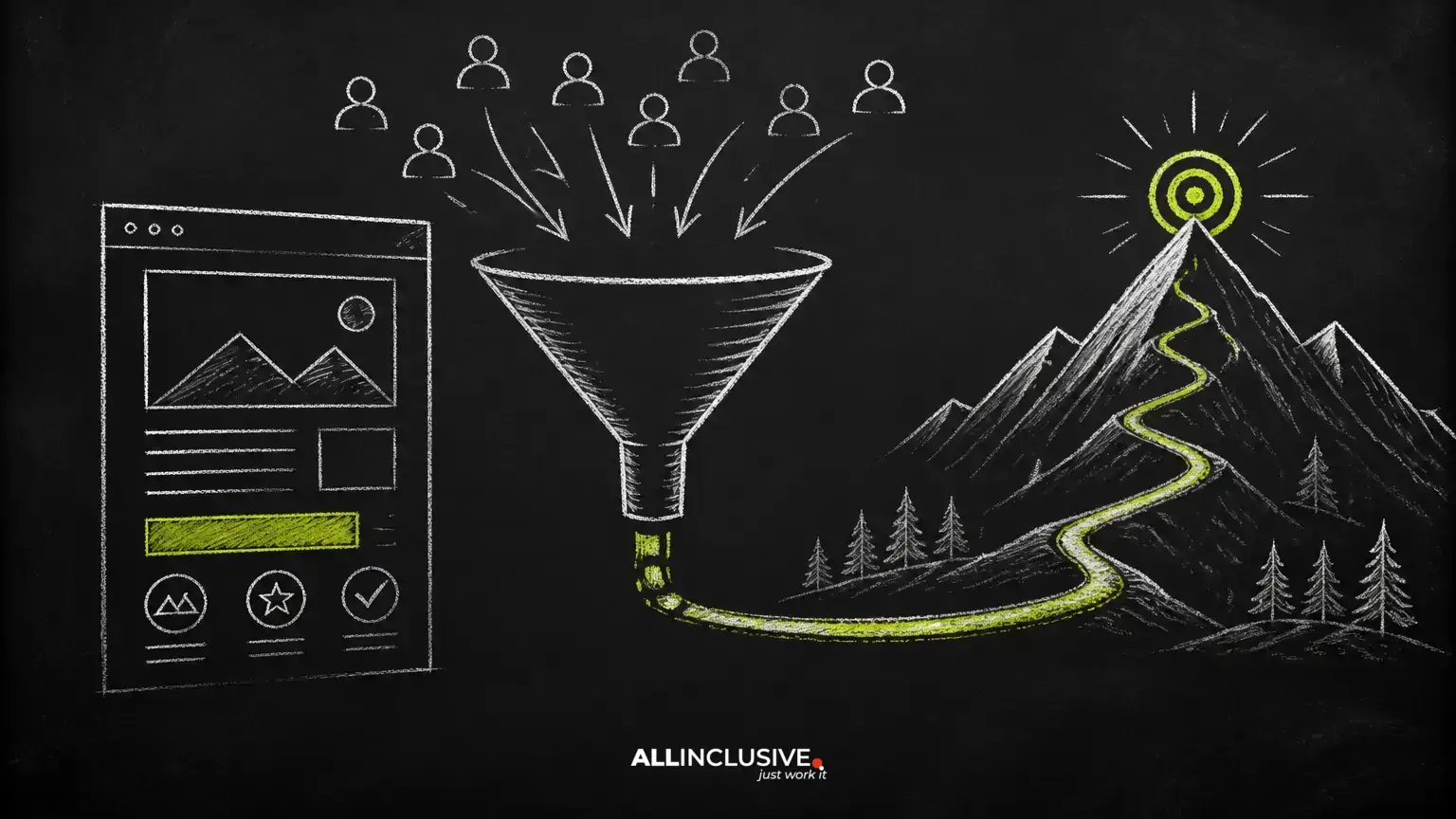
A landing page can be beautifully designed and still underperform if the people searching for its offer cannot find it. It can also attract organic traffic without producing meaningful leads if the page does not answer the visitor’s question or make the next step clear.
Search-friendly landing pages balance visibility with action. They target a specific need, explain the offer plainly, reduce uncertainty, and give qualified visitors an obvious path forward. That balance matters whether the page promotes a service, product, event, consultation, download, or other conversion.
This guide presents a durable process for creating and improving landing pages for organic search while protecting the focused experience that makes landing pages useful.
What makes a landing page SEO-friendly?
An SEO-friendly landing page is a focused page built around a defined audience, search intent, and conversion goal. It provides enough relevant information for a visitor to evaluate the offer, while keeping the primary action visible and understandable.
SEO does not require every landing page to become a long-form article. The appropriate length depends on the question, the competitiveness of the topic, the complexity of the offer, and the information a prospective customer needs before acting. A page should be complete rather than artificially long.
Before creating or revising a page, define:
- Audience: Who is the page intended to help?
- Need: What problem or task brought the visitor to search?
- Intent: Is the visitor learning, comparing options, evaluating a provider, or ready to act?
- Offer: What exactly does the page provide?
- Conversion: What single primary action should the visitor take?
Start with search intent, not a keyword list
Keyword research is useful when it helps clarify what people want. It becomes less useful when it turns into a list of phrases to insert into a page without understanding the underlying problem.
Review the language used by your audience and group terms by intent. Informational searches may need education first. Commercial investigation searches may require comparisons, process details, proof, pricing context, or answers to objections. Transactional searches usually need a direct path to purchase, booking, or contact.
Choose one primary topic for the landing page and identify closely related questions that help visitors make a decision. For example, a page about local accounting services might need to address service scope, business size, location, onboarding, timelines, and the information required to begin. These supporting topics are more useful than repeating the same phrase in every section.
Use a clear page brief
A short brief can prevent both underdeveloped content and unnecessary detail. Include the primary intent, audience, offer, desired action, supporting questions, differentiators that can be substantiated, and pages that should receive or provide internal links.
Review competing search results as a source of questions, not as a template to copy. Look for common expectations, missing explanations, and opportunities to make the page more specific or easier to use. Do not assume that every element appearing on another page is necessary for yours.
Build a page structure that supports readers and crawlers
Clear structure helps visitors scan and helps search systems interpret relationships between topics. Use one descriptive page title in the CMS, a concise meta description, and a logical heading hierarchy. The visible introduction should quickly confirm who the offer is for and what outcome the page supports.
A practical landing page structure may include:
- Value proposition: State the audience, problem, and relevant outcome.
- Offer details: Explain what is included, how it works, and what the visitor can expect.
- Evidence: Use accurate testimonials, examples, credentials, demonstrations, or process details where available.
- Objection handling: Address common concerns about fit, cost, timing, requirements, or risk.
- Conversion section: Present a clear call to action and explain what happens next.
- Helpful supporting content: Answer questions that affect the decision without diverting attention from the primary action.
Use headings to describe the actual section that follows. Do not force secondary phrases into headings if they make the language awkward. Short paragraphs, descriptive lists, meaningful link text, and well-labeled forms improve usability without relying on search-engine folklore.
Write content that earns action
Landing-page copy should be specific enough to support a decision. Replace broad claims such as “best,” “leading,” or “innovative” with explanations that a reader can evaluate. Describe the process, deliverables, eligibility, limitations, expected inputs, and next steps where relevant.
Match the call to action to the visitor’s readiness. A person comparing providers may need an assessment, sample, or consultation before a purchase. A visitor searching for a straightforward product may need a direct purchase action. Avoid presenting several competing primary actions unless the user genuinely has several equally important paths.
Use trust signals responsibly
Trust elements should reduce uncertainty, not create an impression that cannot be verified. Use real customer feedback with permission, accurate credentials, clear policies, transparent contact information, and concrete examples. If a claim depends on a date, market condition, certification, or performance result, verify it before publication and review it periodically.
Do not add testimonials, statistics, awards, partnerships, or guarantees merely because they appear on other pages. Unsupported proof can damage credibility and create compliance concerns.
Optimize on-page elements
Title and meta description
Write a title that identifies the page’s subject and, where useful, its audience or benefit. Keep it natural and distinct from other important pages. The meta description should accurately preview the page and make the likely next step clear. Search engines may rewrite snippets, so treat the description as useful page metadata rather than a guaranteed result-page message.
URL
Choose a short, readable URL that reflects the page’s stable topic. Use words a person can understand, separate concepts with hyphens, and avoid unnecessary dates, parameters, or repeated keywords. Change an existing URL only when the benefit justifies migration work; if you do change it, map the old address to the new one and update relevant internal links.
Images and media
Use media when it clarifies the offer or demonstrates an important process. Compress files appropriately, serve suitable dimensions, and write alt text that describes the image’s meaningful content. Decorative images generally need empty alt text rather than keyword-filled descriptions.
Links and calls to action
Link to closely related pages when doing so helps visitors understand the topic or continue their evaluation. Descriptive anchor text is more useful than vague labels such as “click here.” A landing page can link to a broader content marketing strategy resource when readers need additional context, and relevant service pages can link back to the landing page when it is the most useful next step.
Protect technical quality and user experience
Technical optimization cannot compensate for an unclear offer, but technical problems can prevent a strong page from being discovered or used. Check that the page is indexable when organic visibility is intended, has a self-consistent canonical setup, uses a mobile-friendly layout, and does not depend on inaccessible scripts for essential content or form completion.
Performance should be evaluated from the user’s perspective. Reduce unnecessarily large images, limit avoidable third-party resources, and review layout stability. Test the page on the devices and connection conditions used by your audience. A fast page is not automatically effective, but unnecessary delay and layout friction can undermine both trust and conversion.
Forms deserve special attention. Ask only for information needed at that stage, label fields clearly, explain errors, provide accessible controls, and tell users what happens after submission. If a form is the primary conversion, test it independently from the rest of the page.
Use internal linking to establish context
Internal links help visitors discover supporting information and help search systems understand how a landing page fits within the site. Link from relevant, established pages using wording that accurately describes the destination. Avoid adding large blocks of unrelated links solely to increase link counts.
For a site developing an organic acquisition program, the landing page can sit within a broader content marketing cluster. Where the page relates to search visibility or technical recommendations, a contextual link to SEO services may also help readers choose an appropriate next step. The links should serve a clear user need rather than interrupt the conversion path.
Earn authority without risky shortcuts
External links to a landing page are more likely when the page is genuinely useful, specific, and easy to reference. Create assets that solve a real information gap, such as a clear methodology, original framework, practical checklist, decision guide, or well-documented example. Promote the resource to people who already have a reason to care.
Avoid buying links, participating in manipulative exchanges, or creating low-value pages for the sole purpose of attracting links. Authority is not a substitute for relevance, and a large number of weak links does not make an offer more credible.
Measure both visibility and business value
Review landing pages using multiple signals. Search impressions and clicks can indicate whether the page is being discovered for relevant queries. Engagement patterns, form starts, qualified submissions, purchases, bookings, and assisted conversions help determine whether the traffic is useful.
Interpret results carefully. A lower click-through rate may reflect a mismatch between the snippet and the page, while a low conversion rate may indicate weak intent alignment, unclear positioning, excessive form friction, or an offer that does not fit the audience. Use page-level analysis where available, compare changes over a reasonable period, and document what was changed before drawing conclusions.
Refresh the page when the offer, audience questions, process, regulations, or supporting evidence changes. Remove obsolete claims and redirect or consolidate pages that substantially overlap. Do not update a page merely to change a date or add keywords without improving its usefulness.
A practical landing-page launch checklist
- The page has one defined audience, intent, and primary conversion.
- The offer and next step are clear above the main decision point.
- Content answers the questions a qualified visitor needs answered.
- Title, description, URL, headings, and media accurately describe the page.
- Forms, buttons, links, and important content work on mobile and desktop.
- Indexing, canonical, redirects, and internal links have been checked.
- Claims, proof, testimonials, and time-sensitive details are verified.
- Conversion and organic-search measurement are configured appropriately.
Conclusion
Effective landing-page SEO is the practice of aligning a specific search need with a credible offer and an easy next step. Start with intent, create genuinely useful content, make the page technically accessible, connect it to relevant site content, and measure outcomes beyond rankings alone. When visibility and conversion design support the same audience need, the landing page can contribute to both discovery and sustainable growth.