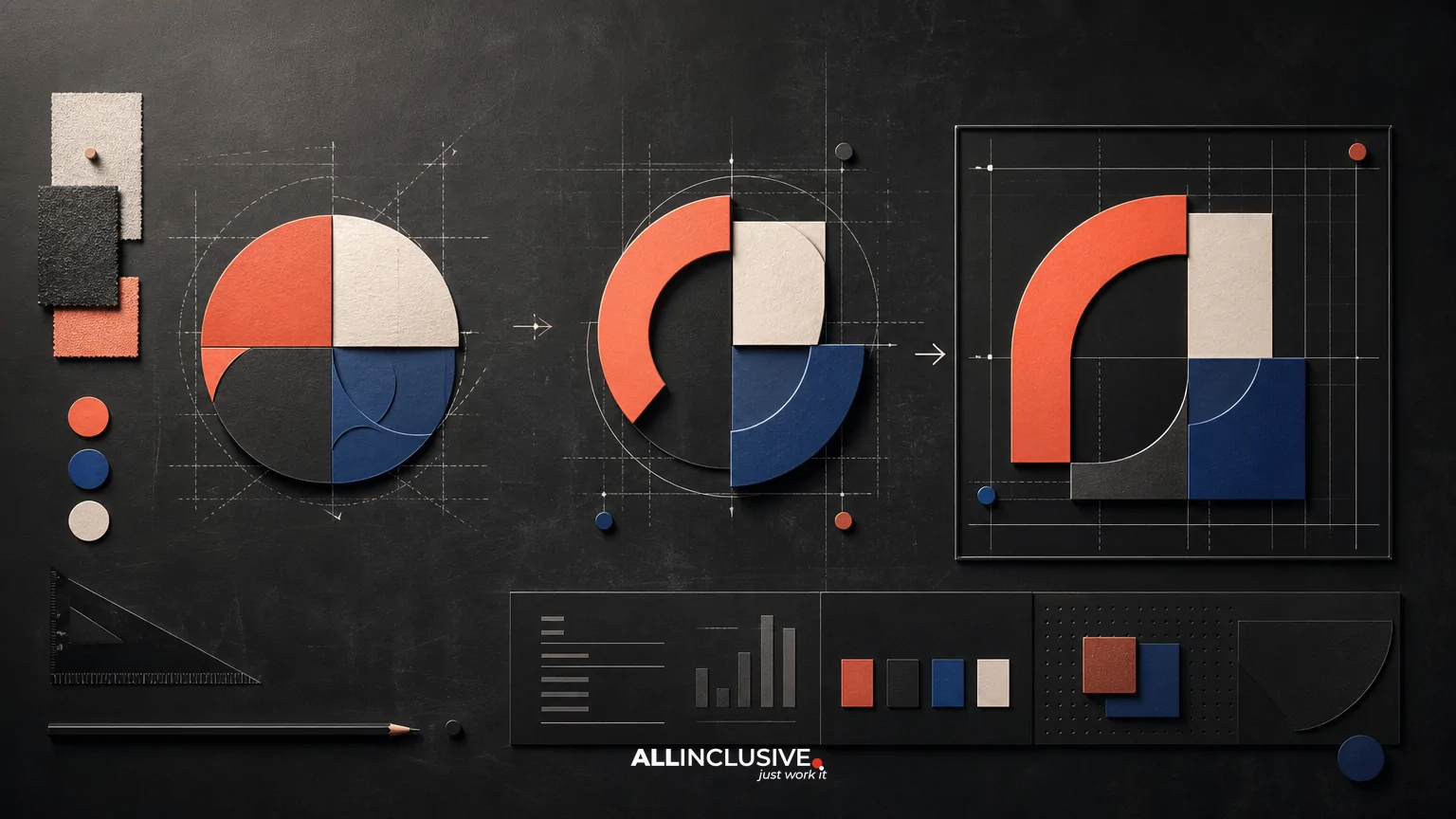
Rebranding without losing recognition is a matter of managing change, not avoiding it. The safest approach is to identify which brand assets carry existing equity, preserve the strongest signals, and modernize the parts that no longer support the business.
That usually means making deliberate decisions about scope. A visual refresh may improve clarity and consistency without disrupting recognition. A broader rebrand may be necessary when the company’s positioning, audience, products, or market context has materially changed. In either case, the work should begin with diagnosis rather than design preference.
Start by defining why the brand needs to change
A brand can look dated while still being valuable. It can also look polished while creating confusion about what the company does. Before changing a logo, color palette, website, or messaging system, document the business reason for the work.
Common triggers include:
- A merger, acquisition, or major change in ownership
- Expansion into new markets or customer segments
- A product portfolio that has outgrown the current identity
- Inconsistent execution across teams, locations, or channels
- A visual identity that is difficult to use in digital environments
- Positioning that no longer reflects the company’s actual value
- Confusion with competitors or legacy perceptions that limit growth
The reason matters because it determines the appropriate level of change. If the problem is inconsistent application, a stronger system and clearer guidelines may be enough. If the company is entering a new category, the positioning and architecture may need more fundamental work.
Identify the recognition assets before redesigning
Recognition does not come from a logo alone. Customers may identify a company through a combination of name, color, typography, shape, imagery, packaging, language, layout, sound, or distinctive product cues. Some assets are highly valuable; others may simply be familiar to the internal team.
Create an equity inventory before approving a new direction. For each recognizable asset, ask:
- Do customers associate this element with the company?
- Does it help people find, choose, or remember the brand?
- Is it distinctive in the category?
- Can it work across current channels and sizes?
- Does it support the company’s future positioning?
- Would changing it create meaningful customer friction?
Use customer interviews, sales-team observations, support questions, search behavior, and stakeholder review to inform the assessment. Internal preference is useful context, but it should not be treated as proof of market recognition.
A helpful output is a simple asset map that classifies elements as preserve, refine, replace, or retire. This creates a clear basis for design decisions and helps prevent every familiar detail from becoming untouchable.
Choose between a refresh and a full rebrand
The central decision is not whether change is good or bad. It is whether the current brand can support the business after targeted improvements, or whether its underlying meaning and structure need to be rebuilt.
| Consider a brand refresh when | Consider a broader rebrand when |
|---|---|
| The name and core positioning remain relevant | The company’s purpose, audience, or category has changed |
| Recognition is strong but execution feels inconsistent | The current identity communicates the wrong promise |
| The logo works conceptually but needs better digital behavior | The identity is confused with competitors or legacy offerings |
| The primary need is improved usability and cohesion | Brand architecture, naming, or messaging is fundamentally unclear |
| Existing equity supports the desired future direction | Preserving the current system would constrain growth |
A refresh can involve refining proportions, simplifying color use, updating typography, improving imagery, clarifying messaging, and building a more usable system. A full rebrand may involve research, positioning, naming, architecture, identity development, and a staged implementation plan. The distinction is about strategic scope, not how dramatic the final visuals appear.
For related decision criteria, review this guide to rebranding and brand equity before selecting a direction.
Use continuity strategically in the visual identity
Modernization does not require preserving every detail. It requires preserving the details that perform useful recognition work.
Logo
When the existing mark has meaningful recognition, test evolutionary changes first. Simplifying small details, improving spacing, creating responsive versions, or adjusting optical balance may solve usability problems without discarding the core form. A more substantial change may be appropriate when the mark is difficult to reproduce, communicates the wrong category, or lacks distinctive structure.
Logo decisions should be tested in realistic contexts: navigation bars, mobile screens, social avatars, presentations, signage, proposals, and small-scale print. A mark that looks improved in a large presentation may fail where customers encounter it most often. For questions about logo-specific scope, see the editorial guidance on logo design.
Color
Color can be a powerful continuity cue, but the exact shade is not always the most important asset. A brand may retain a recognizable color family while improving contrast, accessibility, digital consistency, and secondary color roles. Document primary, supporting, and functional colors so teams do not use a familiar color without a coherent system.
Typography
Typography often offers a low-disruption path to modernization. A clearer type system can improve hierarchy, readability, and perceived quality while leaving stronger recognition cues intact. Define how type behaves across headlines, body copy, data, captions, and digital interfaces rather than selecting fonts in isolation.
Imagery and graphic language
Photography, illustration, iconography, composition, and graphic devices can create continuity even when the logo changes. Establish principles for subject matter, cropping, tone, contrast, and layout. These rules make the identity recognizable through repeated behavior, not just repeated symbols.
Protect verbal recognition as well as visual recognition
Customers recognize brands through language. A change in tagline, product naming, tone, or message hierarchy can be more disruptive than a visual update if it removes familiar meaning without replacing it.
Audit the words customers encounter most often:
- Company and product names
- Category descriptions
- Core value propositions
- Taglines and recurring phrases
- Navigation labels and calls to action
- Sales and customer-support language
Preserve language that customers use accurately and consistently. Update language that is vague, inflated, outdated, or misaligned with the actual offer. If a familiar tagline must change, consider a transition period in which the new message is introduced alongside the old one in selected contexts.
Build a transition system, not just a final design
Recognition is protected through implementation. Even a thoughtful identity can feel like a sudden disappearance if customers encounter disconnected changes across the website, email, packaging, sales materials, and social channels.
Develop a transition system with the following elements:
- Change inventory: List every customer-facing and internal touchpoint affected by the rebrand.
- Priority ranking: Identify high-visibility, high-frequency, and legally or operationally important assets.
- Launch sequence: Decide which channels change first and which can transition later.
- Coexistence rules: Define when old and new assets may appear together and for how long.
- Ownership: Assign responsible teams for approvals, production, updates, and quality control.
- Measurement: Establish feedback signals for confusion, findability, adoption, and consistency.
A rebranding rollout plan can help turn the identity into a controlled operational program. The schedule should account for inventory, vendor lead times, legal review, web development, sales enablement, and employee training—not only launch communications.
Audit touchpoints before and after launch
A touchpoint audit helps reveal where recognition is created, weakened, or contradicted. Review the experience from a customer’s perspective, beginning with discovery and continuing through consideration, purchase, onboarding, support, renewal, and advocacy.
Include both obvious and overlooked assets:
- Website pages, forms, templates, and transactional emails
- Search listings, social profiles, and digital advertising
- Sales decks, proposals, case studies, and one-pagers
- Packaging, shipping materials, signage, and event displays
- Product interfaces, account notifications, and help content
- Invoices, contracts, recruiting materials, and internal templates
Record the current state, intended future state, owner, priority, and replacement timing for each item. The guide to a rebranding touchpoint audit provides a useful framework for this inventory.
Test for recognition, clarity, and confidence
Testing should answer specific questions rather than ask whether people “like” the new design. Separate recognition from preference and preference from business clarity.
Useful questions include:
- Which company or product does this asset appear to represent?
- What category or offer does it suggest?
- What details make it seem familiar or unfamiliar?
- Can users distinguish the new identity from close competitors?
- Does the system remain legible and identifiable at common sizes?
- Do existing customers understand that the new presentation belongs to the same company?
Test representative applications, not only brand boards. Compare old and new assets where appropriate, but avoid teaching participants to search for differences. Use findings to refine the system, especially where recognition depends on details that customers actually use.
Common mistakes that weaken recognition
Changing everything at once without a reason
A dramatic change can create internal excitement while removing useful equity. Scope should follow the business problem, not a desire for novelty.
Preserving weak assets because they are familiar
Familiarity alone does not make an asset valuable. If a device is confusing, inaccessible, indistinctive, or difficult to use, retaining it may preserve a problem rather than recognition.
Focusing on the logo while ignoring the system
A logo cannot compensate for inconsistent messaging, poor layouts, weak content, or disconnected customer experiences. Recognition often comes from the repeated system around the mark.
Launching before the organization is ready
If employees, partners, vendors, and digital teams do not know which assets to use, old and new versions will compete in the market. Prepare templates, files, guidance, and training before broad release.
Treating the launch as the finish line
After launch, monitor real-world applications and correct drift. A brand system becomes credible through consistent use over time.
A practical approval checklist
Before approving a modernization, confirm that:
- The business reason for change is documented.
- Recognition assets have been identified and evaluated.
- The chosen scope matches the business problem.
- Core visual and verbal continuity decisions are explicit.
- Key applications have been tested at realistic sizes and formats.
- Accessibility, production, and digital requirements have been reviewed.
- The rollout includes owners, sequencing, coexistence rules, and deadlines.
- Teams have the templates and guidance needed to execute consistently.
- Post-launch feedback and correction processes are defined.
Final takeaway
Modernizing a brand without losing recognition means protecting meaningful equity while removing friction, inconsistency, and outdated signals. Start with the reason for change, distinguish valuable familiarity from mere habit, select the right scope, and manage implementation as carefully as the identity itself.
When the work requires coordinated strategy, identity, and rollout decisions, the rebranding team can provide the appropriate commercial next step. For broader design-system context, explore design services and capabilities.