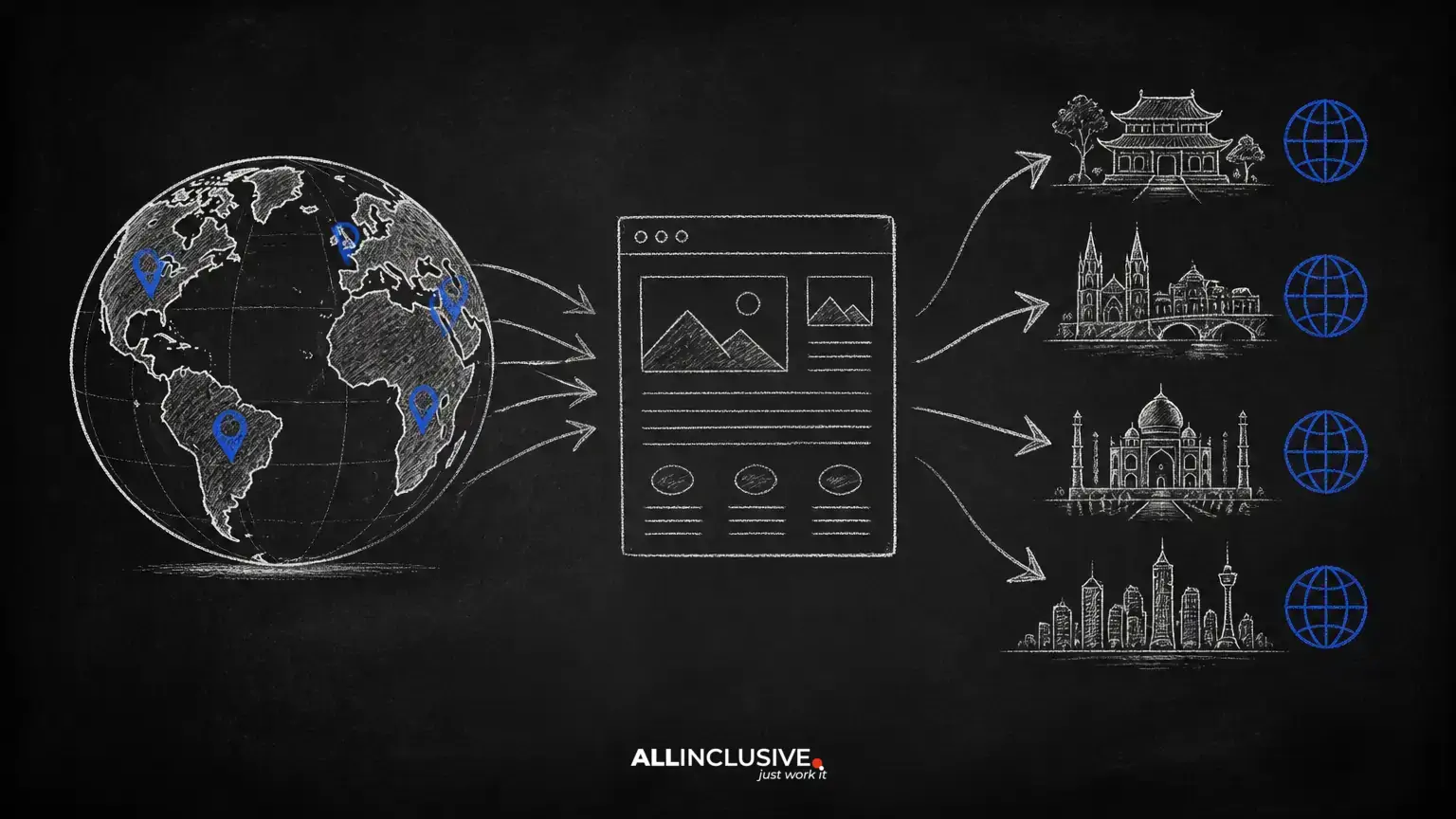
Adding another language to a website can make a business accessible to new audiences, but translation alone does not create multilingual SEO. Search behavior, wording, expectations, regulations, and competition can differ by market. A page that performs well in one language may be irrelevant or difficult to find in another.
A stronger approach treats each language version as a localized search experience. That means researching how people actually search, creating crawlable URLs, translating the meaning and intent of each page, and reviewing the result with someone who understands the target market.
What multilingual SEO includes
Multilingual SEO is the process of making website content discoverable and useful for people who search in different languages. It combines technical implementation, keyword research, content localization, internal linking, structured editorial workflows, and ongoing quality checks. International SEO provides a broader framework for planning multilingual optimization across markets.
Translation remains important, but a direct translation can miss the terms people use, the level of detail they expect, or the local context needed to make a decision. Multilingual SEO therefore asks two questions for every important page:
- What does this page need to communicate accurately?
- How would the intended audience search for and evaluate that information?
For broader search strategy and implementation support, see the SEO services overview. For a local-market focus, the local SEO guide provides related principles around geographic intent and audience relevance.
Decide whether a new language is ready
Launching a language version creates a continuing maintenance obligation. Before publishing, confirm that the business can support more than the initial translation.
Check operational readiness
- Someone can review language quality and cultural appropriateness.
- Customer support can respond to inquiries in the target language, or the site clearly explains available support.
- Products, services, pricing, shipping, payment, and legal information apply to the intended market.
- There is a process for updating translated pages when the source content changes.
- The team can monitor indexing, organic visibility, conversions, and technical errors by language or market.
A smaller, well-maintained launch is often more useful than publishing every page in several languages and allowing the translations to become incomplete. Start with pages that match genuine demand and business capability, then expand when the workflow is reliable.
Research search intent in the target language
Do not build the translation around a bilingual dictionary or an automatic translation of the source keyword list. Research the target language independently. The best term may vary by country, region, audience, or stage of the buying journey.
Build a market-specific keyword map
- List the products, services, problems, and questions relevant to the target audience.
- Collect the natural terms used by customers, sales teams, support staff, and local competitors.
- Review search results to understand whether the intent is informational, commercial, navigational, or transactional.
- Group related terms by page purpose instead of assigning every variation to one page.
- Record regional differences, spelling variants, formal and informal wording, and terms that should not be translated literally.
Search volume can help prioritize topics, but it should not be the only decision factor. A lower-volume term with clear commercial intent may be more valuable than a broad term that attracts visitors who cannot use the offer. Treat third-party volume and difficulty estimates as directional, and verify important decisions against actual performance after launch.
Use native-language review
A fluent reviewer should assess more than grammar. Ask whether the copy sounds natural, uses the expected terminology, communicates the correct level of formality, and reflects how people in the market describe the problem. They should also flag words that have different meanings across countries using the same language.
Choose a crawlable URL structure
Each language or country version should have a distinct, stable URL that search engines and users can access directly. Common approaches include language or country subdirectories, subdomains, and country-code domains. The right choice depends on governance, branding, technical resources, and whether the content is intended for a language group or a specific country.
Subdirectories
A structure such as example.com/fr/ keeps versions within one domain and is often straightforward to manage. It can work well when a central team maintains multiple languages and the brand uses one primary domain.
Subdomains
A structure such as fr.example.com separates language versions more visibly. It may suit organizations with distinct regional teams or technical systems, but it can require careful coordination across properties.
Country-code domains
A country-code domain can communicate a strong country focus, but each domain may require additional technical, editorial, and authority management. Use it when the country distinction is meaningful to the business, not merely because it appears international.
Avoid language selection based only on cookies
A cookie-controlled experience can be convenient for returning visitors, but it should not be the only way to reach a translated page. Search engines and users need indexable URLs that can be crawled, shared, bookmarked, and opened directly. Provide visible language links and allow visitors to change their selection without being trapped in an automatic redirect.
Implement hreflang carefully
Hreflang annotations help indicate which language and, where applicable, country version is intended for a page. They are signals, not a substitute for separate URLs, useful content, or sound indexing controls.
For each translated page, check that:
- The alternate URL exists and returns a successful response.
- The language and regional code accurately describe the page.
- Annotations are reciprocal where the implementation requires reciprocal references.
- The canonical URL and hreflang relationship are not contradictory.
- Language selectors and XML sitemaps do not point to missing or redirected versions.
Use language codes for language targeting and regional codes only when the content genuinely differs by country. Avoid creating near-identical country pages solely to multiply URLs. Test the implementation after releases because templates, redirects, canonical tags, and CMS settings can break international signals without changing the visible copy.
Localize page content, metadata, and navigation
Translate the complete user experience, not just the main paragraph. Important elements include page titles, meta descriptions, headings, URLs where appropriate, image alternative text, buttons, forms, navigation labels, breadcrumb text, product details, and supporting help content.
Preserve the original intent while adapting examples and terminology for the audience. A literal translation may be grammatically correct yet still sound unfamiliar or imply an offer that is unavailable in that market.
Handle keywords without damaging readability
Use important search terms where they naturally describe the page. Do not insert awkward phrases into headings, paragraphs, or anchor text simply because a keyword tool reports a variation. Correct, clear language builds trust and gives search engines better context than repetitive wording.
If customers use abbreviations, missing accents, colloquialisms, or imperfect phrases, record them as research insights. They may inform page targeting, internal search, FAQs, or ad copy, but the visible editorial text should remain understandable and professional unless the audience and context justify a less formal style.
Build a useful translated site architecture
Do not translate every page automatically. Prioritize pages that answer established demand or support important journeys:
- Core service or product pages.
- Location pages where the business genuinely serves the area.
- High-value educational resources.
- Pricing, delivery, returns, eligibility, or onboarding information.
- Contact and support pages.
Link related pages within the same language experience whenever possible. A visitor who lands on a translated service page should be able to reach relevant proof, explanations, FAQs, and conversion paths without being sent unexpectedly to another language.
Review cross-language links carefully. A link to another language can be useful when the content is intentionally shared, but automatic language switching or inconsistent navigation can create confusion and weaken the user journey.
Use machine translation with human controls
Automation can help organize large translation projects, create a first draft, or identify repeated phrases. It should not remove responsibility for accuracy. Sensitive topics, legal content, medical information, financial claims, technical instructions, and conversion-critical pages deserve qualified human review.
Create a translation brief before work begins. Include the audience, market, brand voice, approved terminology, prohibited claims, formatting rules, and examples of preferred wording. Maintain a glossary so recurring product and service terms remain consistent across pages.
Earn relevant visibility after launch
Publishing translated pages does not guarantee discovery. Promote useful resources through relationships and channels that are relevant to the target market. Appropriate opportunities may include local organizations, industry publications, professional communities, partnerships, and legitimate digital PR.
Avoid bulk directory submissions, automated guest-post schemes, paid links intended to manipulate rankings, and unnatural multilingual anchor text. The strongest references usually come from content that is genuinely useful to the audience and appropriate for the referring publication.
Measure each language version separately
Set up reporting that distinguishes languages, countries, directories, or domains. Review indexed pages, impressions, clicks, rankings, engagement, leads, sales, and support feedback. Also monitor technical indicators such as crawl errors, redirect chains, duplicate URLs, broken language links, and accidental noindex directives.
Compare performance by page type rather than assuming the entire language site is succeeding or failing. A translated guide may attract visibility while a service page needs better localization. Use search queries and conversion behavior to refine terminology, page intent, internal links, and calls to action.
Multilingual SEO launch checklist
- Confirm the target market, audience, offer, and support model.
- Research search behavior independently in the target language.
- Select a stable, crawlable URL structure.
- Create a page-level translation and keyword map.
- Localize visible copy, metadata, navigation, forms, and media text.
- Implement and test hreflang where relevant.
- Provide direct language links without relying solely on cookies or forced redirects.
- Review important pages with a qualified native-language editor.
- Check canonical tags, indexability, redirects, sitemaps, and internal links.
- Measure organic visibility and business outcomes by language or market.
Conclusion
Effective multilingual SEO is a localization program supported by technical SEO, not a one-time translation task. Start with a market you can serve well, research the language on its own terms, publish distinct and accessible URLs, and maintain a careful review process. When the content, technical signals, and customer experience agree, a new language version has a stronger foundation for sustainable visibility and trust.