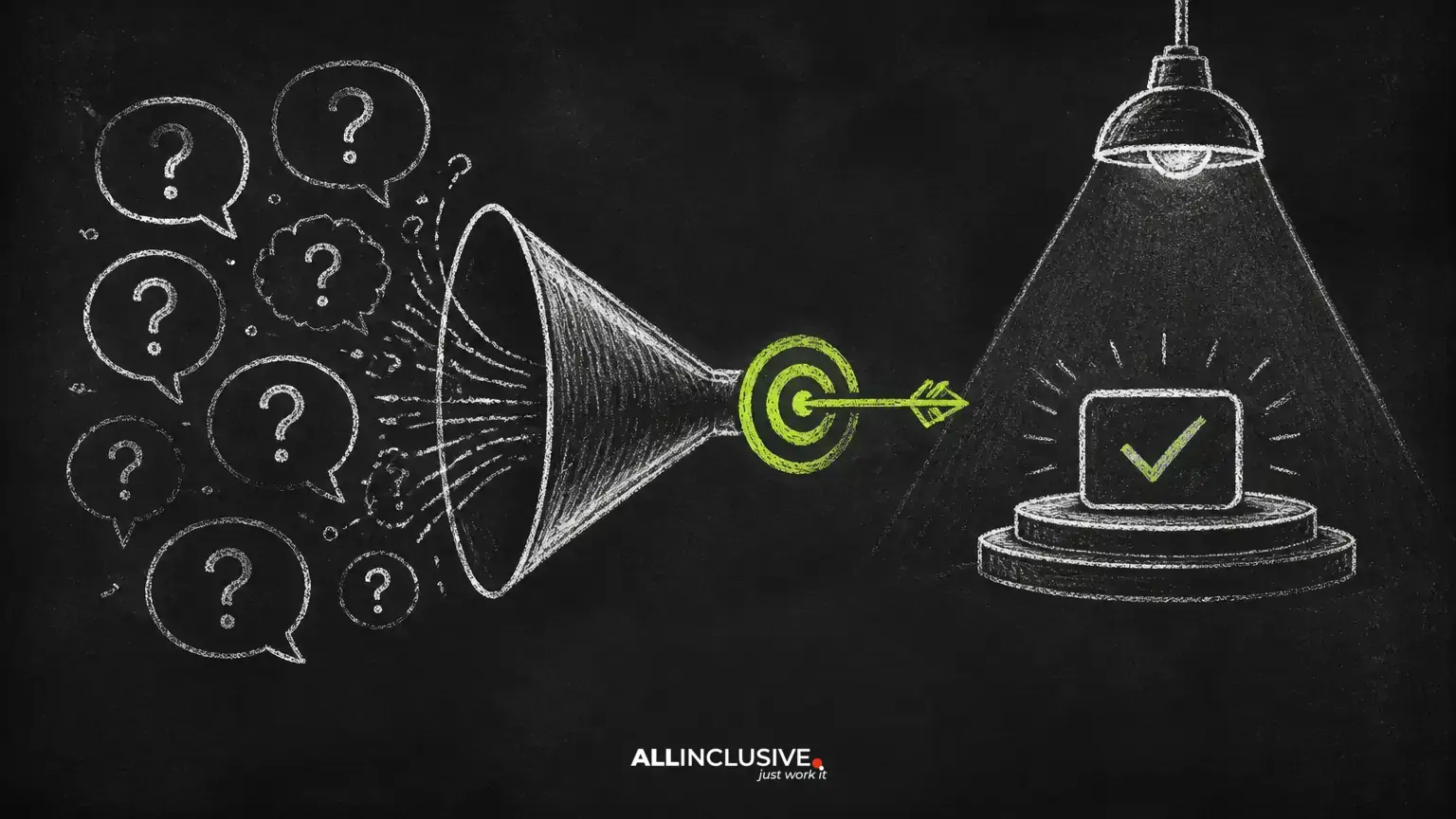
Question keywords are more than phrases that begin with what, why, when, where, who, or how. They are clues about a searcher’s problem, level of knowledge, and expected next step. Used well, they help you create content that is easier to understand and more useful in search results.
Optimizing for questions does not mean repeating a question throughout a page or promising a featured snippet. Search features change, and no markup or formatting guarantees a particular result. The durable approach is to identify genuine questions, give accurate answers, explain the surrounding context, and make the next action clear. This guide shows how to do that as part of a broader SEO strategy.
Why question keywords matter
A question often exposes search intent more clearly than a short head term. Someone searching for “accounting software” may be researching options, while someone asking “how does accounting software help a small business?” is looking for an explanation. “What should I look for in accounting software?” signals evaluation, and “how much does accounting software cost?” introduces a commercial concern.
These differences affect the page you should create. A definition, tutorial, comparison, service page, and buying guide should not compete for the same intent simply because they share a topic.
- Informational questions: seek an explanation, definition, or fact.
- Process questions: ask how to complete a task.
- Evaluation questions: compare options, limitations, or criteria.
- Problem-solving questions: describe an obstacle or symptom.
- Commercial questions: ask about cost, fit, implementation, or providers.
Question research is therefore useful for both content planning and conversion strategy. It can reveal missing sections on existing pages, support articles that deserve their own URLs, and concerns that should be addressed before a visitor contacts a business.
How to find useful question keywords
Start with customer language
List the questions your sales, support, and service teams hear repeatedly. Review customer interviews, intake forms, emails, chat transcripts, product documentation, and community discussions where appropriate. These sources often reveal wording that generic keyword lists miss.
Group the questions by audience, stage, and subject. “How do I fix a slow website?” may belong to a beginner troubleshooting guide, while “How do I diagnose a slow database query?” requires a more technical resource. The words are related, but the audience and expected answer differ.
Use search-result discovery carefully
Search suggestions, related searches, and result-page question modules can generate ideas. Treat them as observations rather than proof of demand or priority. A visible suggestion may be useful, but it still needs to be checked against your audience, business relevance, and ability to provide a better answer.
Keyword research platforms can help expand a seed topic into question variations. Their volume, difficulty, and intent labels are estimates, not guarantees. Use them to organize research, then make the editorial decision based on the actual question and the value of answering it.
Review first-party performance data
Search performance data can show the queries that already expose a page. Look for questions where the page receives impressions but has weak clicks, or where the query is relevant but the current content does not answer it directly. These patterns may suggest a missing section, unclear title, weak introduction, or a need for a separate page.
Do not create a new URL for every wording variation. Several closely related questions may belong in one comprehensive resource. Separate pages are more appropriate when the questions require different formats, audiences, or actions.
Map each question to the right content format
Before writing, decide what a satisfactory answer looks like. A short definition does not need the same structure as a procedure or comparison.
| Question pattern | Useful format | What the page should provide |
|---|---|---|
| What is... | Definition or glossary guide | A plain-language explanation, boundaries, examples, and related concepts. |
| Why does... | Educational explanation | Causes, context, trade-offs, and practical implications. |
| How do I... | Step-by-step guide | Prerequisites, ordered steps, expected outcomes, and troubleshooting. |
| Which is better... | Comparison | Consistent criteria, use cases, limitations, and decision guidance. |
| How much... | Pricing or planning guide | Cost factors, assumptions, ranges only when supportable, and questions to ask. |
Intent can shift over time and vary by audience. Review the current result landscape before committing significant resources, especially for regulated, local, or rapidly changing topics. If the answer depends on current rules, prices, product capabilities, or dates, assign a verification owner and review date.
Write the answer before the background
For a direct question, lead with a direct answer. The first paragraph should tell the reader what is true or what to do, using language that matches the question. Follow it with the reasoning, qualifications, examples, and related details that help the reader apply the answer.
For example, a page targeting “how often should a website be audited?” could begin by explaining that audit frequency depends on site size, publishing activity, technical risk, and business change. It can then describe practical review triggers rather than asserting a universal schedule.
This structure supports people who need a quick answer while preserving depth for readers who need to make a decision. It also makes the page easier to scan, quote, and maintain.
Use headings as questions when they improve clarity
Question-shaped headings are useful when they describe a real subtopic and are followed by a complete answer. Do not turn every heading into a question mechanically. A descriptive heading such as “Choosing an audit cadence” may be clearer than “How do I choose an audit cadence?”
Make procedures genuinely actionable
A how-to page should identify prerequisites, tools or permissions, sequence, expected results, and common failure points. Number the steps when order matters. Explain why a step exists when that context helps readers adapt the process to their situation.
Avoid presenting a procedure as universal when outcomes depend on software versions, account settings, industry rules, or technical environments. State the relevant assumptions and direct readers to verify details before acting.
Build pages that answer the wider topic
A strong question answer usually needs supporting context. Explain important terms, address reasonable follow-up questions, and link to deeper resources instead of forcing every detail into one page. This creates a useful topic structure without producing a collection of thin pages that repeat one another.
Use internal links with descriptive anchor text. A question about improving organic visibility may naturally point to the SEO services overview, while a technical implementation question may link to a relevant technical guide or contact path. Only add links that help the reader continue their task.
Review the page for factual completeness, author responsibility, and source quality. Topics involving health, finance, law, safety, or significant purchases need especially careful review. Make clear what is general information and what requires a qualified professional.
Use structured data only when it matches the page
Structured data can help search engines interpret eligible content, but it is not a shortcut to visibility and does not guarantee enhanced search treatment. Markup should accurately describe content that is visible to users and should follow the current documentation for the relevant format.
Do not add FAQ, HowTo, Q&A, Product, or other structured data merely because a page contains a question. Each type has its own eligibility conditions and intended use. Validate implementation, monitor warnings, and remove markup that no longer reflects the page.
More important than markup is the underlying experience: a clear answer, accurate information, accessible presentation, useful navigation, and a page that satisfies the visitor’s task.
Measure usefulness, not just rankings
Evaluate question-focused content using a group of signals:
- Relevant impressions and clicks for the intended questions.
- Engagement patterns that indicate whether visitors found the answer useful.
- Completion of meaningful actions, such as contacting a provider, starting an evaluation, or reading a related guide.
- Conversions assisted by the page, when reliable attribution is available.
- Feedback from customers, support teams, and subject-matter reviewers.
A ranking or search feature is not the objective by itself. A page can attract impressions without helping the audience, while a focused page can support qualified visitors without producing large traffic numbers. Compare performance with the page’s intended role and improve the weakest part of the experience.
A practical workflow for question-keyword optimization
- Collect questions: combine customer language, search discovery, keyword research, and first-party performance data.
- Cluster by intent: group questions that deserve one answer and separate those requiring different formats or audiences.
- Choose the page role: define whether the resource educates, helps someone complete a task, compares options, or supports a commercial decision.
- Draft the direct answer: answer the primary question near the beginning without overstating certainty.
- Add useful depth: include examples, steps, caveats, related questions, and next actions.
- Review accuracy: have an appropriate subject-matter reviewer check important claims and identify time-sensitive details.
- Improve discoverability: use a precise title, logical headings, descriptive links, and a concise meta description.
- Measure and update: review query patterns, user behavior, feedback, and factual changes on a defined schedule.
Common mistakes to avoid
- Chasing every question: relevance to the audience and business matters more than a large list of phrases.
- Repeating exact wording: natural language and clear concepts are more useful than forced keyword repetition.
- Promising a featured snippet: search appearance is controlled by the search engine and can change.
- Using unsupported numbers: omit statistics, prices, timelines, or performance claims that cannot be verified.
- Creating near-duplicate pages: consolidate overlapping questions when one resource can satisfy them well.
- Hiding the answer: do not make readers search through an introduction before reaching the main point.
- Ignoring maintenance: question answers become misleading when products, policies, standards, or market conditions change.
Conclusion
Question-keyword optimization is best understood as intent-led content planning. Find the questions your audience actually asks, determine what a useful answer requires, present that answer clearly, and support it with accurate context and practical next steps. Structured data and search features may assist discovery, but they cannot replace trustworthy content or a page that solves the visitor’s problem. An on-page SEO checklist can help turn these clear answers and supporting details into a page structure that serves both visitors and search engines.
When this process is connected to a broader technical, content, and measurement plan, question research becomes a durable part of SEO rather than a short-term attempt to capture a particular search result.
For related guidance, see Contact.