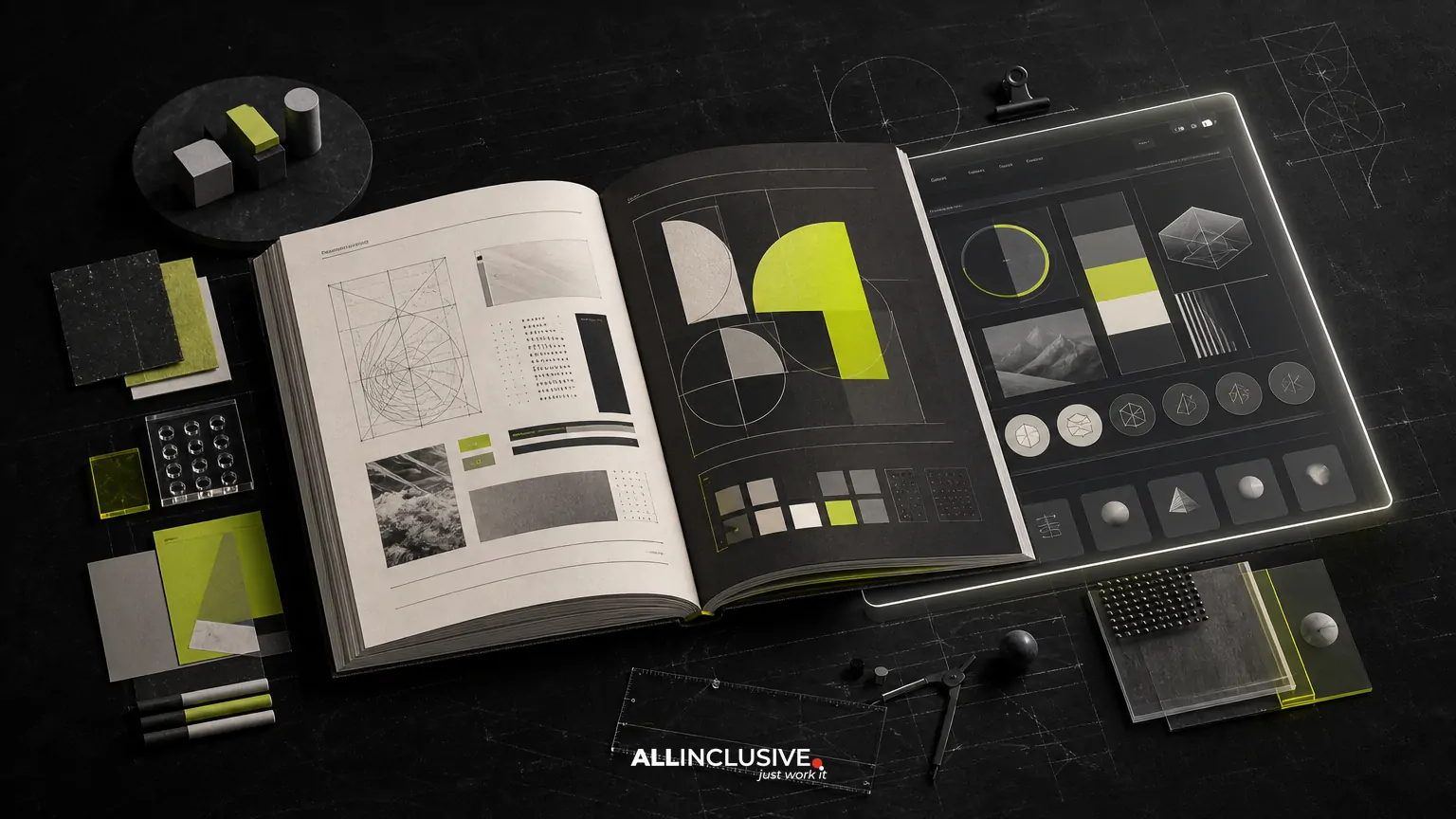
When teams compare digital brand guidelines vs PDF, the real question is not which format looks more modern. It is which format helps people apply the brand correctly, find approved assets quickly, and keep guidance current as the organization grows.
A PDF brand book is often the strongest format for a controlled, portable reference. Digital brand guidelines are usually better for active use: searching rules, viewing application examples, connecting guidance to assets, and updating information without redistributing a new file. For many B2B organizations, the most scalable answer is a combination: a concise PDF for formal reference and a web-based or collaborative system for daily adoption.
What is a PDF brand book?
A PDF brand book is a fixed document that presents the brand system in a defined sequence. It commonly covers the logo, color palette, typography, imagery, layout principles, voice, and examples of correct application.
Because the file can be downloaded, attached, archived, and shared with vendors, a PDF is useful when stakeholders need a stable version of the brand standard. It can also provide a polished overview for executives, partners, investors, and production teams.
Strengths of a PDF brand book
- Portable: teams can open it without a specialized platform or account.
- Fixed: a dated or versioned file creates a clear snapshot of approved guidance.
- Presentable: the format supports a carefully sequenced narrative and strong visual editorial design.
- Easy to archive: procurement teams, agencies, and vendors can retain the exact version used for a project.
Limitations of a PDF brand book
- Information can become outdated while old copies continue circulating.
- Long documents may be difficult to search or navigate during production.
- Asset links, downloads, and examples may require extra maintenance.
- Different audiences may struggle to locate only the rules relevant to their work.
What are digital brand guidelines?
Digital brand guidelines are an online or collaborative version of the brand system. They may live on a dedicated guidelines site, within a design platform, or alongside an organized asset library. The experience usually prioritizes navigation, search, linked files, examples, and ongoing updates rather than a single linear reading path.
A digital system can still contain the same foundations as a PDF: logo usage, color, type, imagery, voice, layout, and applications. The difference is that the guidance is designed for repeated operational use by employees, designers, marketers, developers, sales teams, and external partners.
Strengths of digital brand guidelines
- Searchable: users can reach a specific rule or asset without scanning every page.
- Connected: guidance can link directly to downloadable logos, templates, fonts, components, and examples.
- Maintainable: updates can be published in one place rather than redistributed as attachments.
- Audience-friendly: sections can be organized for marketing, product, communications, events, or vendors.
- Operational: application examples can show how principles work across real channels and formats.
Limitations of digital brand guidelines
- A platform, hosting environment, or collaborative tool may require administration and access management.
- Users may not know which page or file is the current source of truth unless ownership is explicit.
- Online guidance can become fragmented if rules, assets, and templates are maintained separately.
- A poorly structured digital system may feel like a file repository rather than a practical brand tool.
Digital brand guidelines vs PDF: the practical comparison
| Decision factor | PDF brand book | Digital brand guidelines |
|---|---|---|
| Primary role | Stable reference and formal presentation | Daily application and ongoing operations |
| Updates | Require a revised file and redistribution | Can be maintained in a central published system |
| Navigation | Linear reading, bookmarks, and document search | Sections, search, filters, and contextual links |
| Asset access | May include links or attachments | Can connect rules directly to current assets |
| Vendor sharing | Simple to download and attach | Useful when vendors need current, specific guidance |
| Governance | Version dates and file ownership are essential | Permissions, publishing workflow, and ownership are essential |
| Best user experience | Reading and reviewing the complete system | Finding and applying a specific rule quickly |
Which format scales better?
Digital guidelines generally scale better when the brand is changing frequently, serving many teams, or producing a high volume of content. They reduce the friction between a rule and its application. A marketer can find the approved campaign lockup, a developer can review interface color guidance, and a vendor can access the latest production specifications without relying on an old email attachment.
PDF remains valuable when the organization needs a stable, comprehensive record. It is particularly useful for launch documentation, formal handoffs, board or partner presentations, and situations where recipients need an offline reference.
The strongest system treats scale as more than document size. Consider how many people use the guidance, how often the brand changes, how many channels require application, and how much risk exists when an outdated asset is used.
When a PDF brand book is the better choice
- The brand system is relatively stable: updates are occasional and the audience mainly needs reference material.
- The document is part of a formal launch: stakeholders need a polished, complete overview of the new identity.
- External access is limited: vendors or partners need a file they can retain and circulate internally.
- The audience prefers a guided narrative: the brand needs to explain its strategy and visual logic before presenting rules.
- Offline access matters: teams work in environments where reliable platform access is not guaranteed.
When digital guidelines are the better choice
- Many teams apply the brand: marketing, product, sales, recruiting, events, and communications all need different sections.
- The brand changes regularly: campaigns, products, templates, or digital components are updated throughout the year.
- Asset volume is high: people need direct access to current files rather than instructions alone.
- Consistency is difficult to monitor: the organization needs one visible source of truth for internal and external users.
- Applications are complex: examples across web, social, presentations, packaging, motion, or product interfaces are more useful than abstract rules.
The scalable answer: use both formats intentionally
A PDF and a digital system do not need to compete. They can serve different moments in the adoption lifecycle.
- Build the core system: define the identity foundations, including logo, typography, color, imagery, voice, layout, and key applications.
- Create a concise PDF: document the system in a polished, versioned reference that can be shared and archived.
- Develop the digital source of truth: organize practical guidance, current assets, templates, examples, and workflow information for daily use.
- Connect the formats: place the digital location and version information in the PDF, and provide a downloadable overview within the digital experience where appropriate.
identify who approves changes, maintains files, retires old assets, and communicates important updates.
The goal is not to duplicate every page in two places. The PDF should provide clarity and permanence; the digital system should provide access, context, and maintenance.
What a scalable brand-guideline system should include
1. Clear foundations
Start with the elements people must understand before they create anything: brand purpose or positioning where relevant, logo rules, color specifications, typography hierarchy, imagery direction, graphic devices, and voice principles.
2. Application examples
Rules become more useful when they show decisions in context. Include examples for the channels that matter most, such as websites, presentations, social content, email, sales materials, events, packaging, or product interfaces. Explain why examples work, not only whether they are approved.
3. Current assets and templates
Link guidance to the files people actually need. Organize assets by use case and identify file types, color modes, dimensions, and usage restrictions when those details affect production.
4. Governance and version control
Display the owner, last update date, version status, and change summary. Define what happens when a new logo, campaign, template, or product feature changes the system. Without governance, even a well-designed digital library can become ambiguous.
5. A route for questions
Users need to know where to ask when a situation is not covered. A clear review process prevents unofficial workarounds and helps the brand team identify gaps in the guidance.
Common mistakes when choosing a format
- Choosing based on appearance alone: a polished document is not automatically easy to use, and a digital interface is not automatically well governed.
- Publishing rules without examples: users often need to see how guidance translates into real deliverables.
- Separating assets from instructions: disconnected folders encourage people to download whichever file they find first.
- Keeping multiple unofficial sources: old PDFs, shared-drive folders, and duplicated templates create uncertainty.
- Ignoring internal adoption: guidance should reflect how teams actually create, approve, and distribute work.
- Failing to plan maintenance: every system needs an owner, review cadence, and process for retiring outdated material.
A decision checklist
Use these questions before selecting a primary format:
- How often do the identity, templates, or applications change?
- Who needs the guidance: designers, employees, vendors, developers, partners, or all of them?
- Do users need a complete narrative, quick answers, current assets, or all three?
- How many channels and markets must the system support?
- Can one team own publishing, permissions, versioning, and asset maintenance?
- What is the risk of an outdated logo, color, message, or template being used?
- Which materials need a permanent, downloadable record?
These answers usually point toward a clear role for each format. A small team with a stable identity may need a well-structured PDF and a disciplined asset folder. A growing organization with frequent content production will often benefit from a digital system supported by a concise PDF reference.
How this fits into the broader design system
Brand guidelines are one part of a larger design operation. The identity defines recognizable elements and behavior; applications show how those elements work in context; production workflows make them repeatable. If the organization is revisiting its identity foundations, review the difference between brand identity and its day-to-day expression before deciding what the guidelines should contain.
For a broader view of how design decisions connect across business touchpoints, explore design services and disciplines. Teams comparing platform-based documentation with a PDF may also benefit from the related discussion of Figma brand books versus PDF brand books. If the system will live online, consider the practical requirements covered in website brand guidelines.
Final takeaway
Digital brand guidelines scale better for active, distributed, frequently updated brand operations because they make rules, examples, and assets easier to find and maintain. PDF brand books remain valuable as stable, portable, presentation-ready references. For most organizations with multiple audiences or evolving content needs, the most resilient approach is not digital versus PDF; it is a governed digital source of truth supported by a carefully edited PDF edition.
For help defining the structure, content, and format of a complete system, review the brand guidelines resource and use this comparison to shape your internal requirements.